

Technological Salvation? Really? Part 5.
Thesis, Antithesis, Synthesis, Continued.
Will we in the human race find our salvation in a techno-messiah? Will Superintelligence eliminate human vicissitudes? Will Transhumanism provide immortality?
In the previous post, “Substack H+ 2025. Technological Salvation? Really? Part 4,” we outlined the topic in terms of philosopher Hegel’s trialectic: Thesis, Antithesis, and Synthesis. We illustrated the thesis — that powerful AI could bring us utopia and Transhumanism could bring us everlasting life — by looking at Dario Amodei’s prediction of dramatic human flourishing to be brought to us courtesy of advancing AI. We also looked at the promises of Transhumanism to foster either radical life extension or cybernetic immortality. And we looked at religious traditions — Unitarian/Universalism, Mormonism, and Buddhism — welcoming transhumanism into their soteriologies.
Here in this post, we turn to Antithesis and Synthesis.
Antithesis
“Just hold on a darned minute!” shout critics. As mentioned in the previous post, the antithesis issues a warning to avoid idolatry. H+ is Promethean. It is Frankensteinian. It plays God rather than letting God be God. “Medical progress is good,” Santa Clara University’s Brian Patrick Green alerts us. “But if the [transhumanist] goal is immortality and godlikeness without God, then there are serious underlying ideological problems”(Green, 2022, 150).

In a recent address delivered on February 5, 2026, to a conference on this topic at the Mexican Jesuit Universidad Iberoamericana, Carolina A. Sanz de la Fuente warns us against technoscientific idolatry.
“My critique of transhumanism’s instrumentalist understanding of technology and its posthuman is not produced by technology per se but by essentialist idolatrous aspects. When the act of invention welds inseparably with the idolatrous logic that mirrors its creators, the results will only be accepted by those gazes sharing its aim. More so, if the controlling anerotic gaze, which feeds the unilateral binary epistemology, consigns these idols, their aim becomes exceptionally narrow, and the excluded contenders increase. It is the intensity of today’s technophobic and technophilic disagreements that evidence that transhumanism’s posthuman and post-secular technologies are no more than idols” (De La Fuente 2/5/2026).
For some, the threat is even more ominous. “Transhumanism is Satanic,” warns Brandon Gallaher at the University of Exeter. Why Satanic? Because “transhumanism tempts us to abandon the route to divine self-realization mapped by the classical Orthodox understanding of theosis or deification. In transhumanism, Satan tempts us with an alternative to God, namely, ourselves” (Gallaher 2022, 161).
Hava Tirosch-Samuelson, a professor of Jewish Studies at the University of Arizona, fears that technoscience will cause us to miss what is genuinely human in our God-given natures. “Jewish thinkers and other rational humanists should reject transhumanism because it calls for the planned obsolescence of the human species” (Tirosch-Samuelson 2022, 183).
According to de la Fuente, Gallaher, and Tirosch-Samuelson, we should keep our hands off the H+ idols.
Christian theologian Carmen Fowler LaBerge explains why. She admonishes us to discern the spirits, so to speak, and to put technoscience into its proper place. Science and technology are tools we employ to enhance the quality of life within God’s creation, not the power of salvation. This places AI, IA, and H+ in the category of ethical deliberation.
“From a Christian worldview, technology is not inherently good nor evil. Technology is morally benign but we are not. Human beings who develop and use technology are moral agents who stand responsible before God who defines the boundaries of good and evil. So, part of what Christians bring to the transhumanist conversation is the question of should“ (LaBerge 2019, 774).
Synthesis
Our synthesizers recognize the magnificent potential of advancing technology but, like the antithesists, fear that excessive trust in human progress risks idolatry. So, synthesists take what I dub a stewardship approach, subordinating technological advance to the church’s mission and the common good. Synthesists may even incorporate AI, IA, and H+ within the pursuit of virtue, sanctification, and theology.

One rising star on the theological horizon is Micah Redding, founder of CTA (the Christian Transhumanist Association). The CTA mission includes cooperating with God in the redemption, reconciliation, and renewal of the world. With this purpose in mind, Redding proposes a conversation between technology and theology.
“Christian transhumanism is a conversation, first of all. This conversation could lead to an emerging theology of technology which frames technology as an outworking of the imago Dei, the divine image at work in the human species. The imago Dei defines the human species, at least in part, as God’s created co-creator. Further, I recommend that we explore how technology can participate in God’s redemptive purposes, to see technology’s profound significance for God’s eschatological future” (Redding 2022, 113).
With moderately less enthusiasm yet still celebrating the marvelous potential of technoscience to contribute to human flourishing, geneticist-theologian Arvin Gouw introduces a New Transhumanist Theology (A. Gouw, Epilogue: Introducing a New Transhumanist Theology 2022). Gouw recommends we put on H+ glasses and then read Holy Scripture through a transhumanist lens. Similarly, Gouw recommends that we formulate familiar doctrines such as creation and redemption in light of human creativity. In short, the ambitious innovations of our techie friends provide resources for the advance of the Christian mission – and the mission of other faith communities – to do God’s will on Earth.
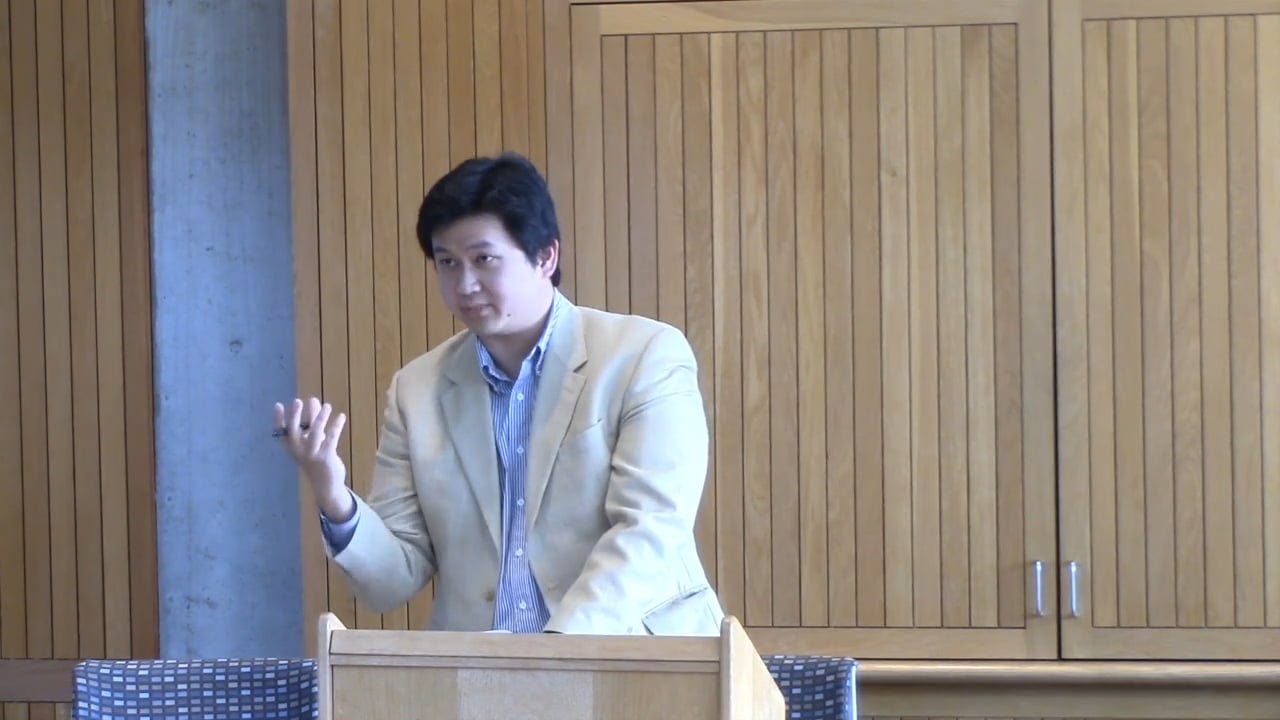
What Gouw adds is important to the public theologian, I think. Gouw affirms that the theologian brings distinctive resources to bear on understanding the world situation. This includes theological perspectives that render a critique of technoscience, especially a critique of playing God. “Transhumanist theology being driven by humanism does have hubris tendencies that need to be corrected” (A. Gouw 2022, 423).
Gouw’s New Transhumanist Theology retains its prophetic judgment.
”Today’s Christian theologians reserve the right to critique modern science when it makes claims that are not scientific….The claim that science will become the savior of society…is excessive” (A. Gouw 2022, 411).
If we bring into this conversation the editor of Reviews in Science, Religion, and Theology, Luis Oviedo in Spain, we could affirm the value of theology for correcting the excesses of technosicnce. “Could we say similarly that theology saves science from its worst risks and dangerous drives?” (Oviedo 2025, 57).
Conclusion
On the one hand, I want to thank God that we have scientists and techies with the can-do ambition to improve human health and wellbeing. Though visions of radical life extension or cybernetic immortality seem to defy the laws of nature as we know them, I congratulate our innovators for dreaming big.
Big dreams are not the problem. The problem derives from proclaiming a soteriology built solely on technoscience. This is a problem for two reasons. First, it underestimates the dramatic power of destruction that could be unleashed by human sin. Second, this is also a problem because it bypasses the offer of a loving God to grant us salvation as a gift of grace.
I treasure my friends in all three camps: thesis, antithesis, and synthesis. As we move into our shared future, I advise public theologians in all faith communities to embrace even the most dramatic technoscientific advances while keeping in mind that they are but tools for use in carrying out God’s commission to make this a better world for all living creatures.

Substack H+ 2026. Technological Salvation? Really? Part 5. Thesis, Antithesis, Synthesis, Continued.
“Machine Intelligence, Artificial General Intelligence, Super-Intelligence, and Human Dignity” Religions
“Cybertheology and the Ethical Dimensions of Superintelligence: A Theological Inquiry into Existential Risks,” Khazanah Theologia
“Christian Transhumanism and Transhumanist Christianity,” Scientia et Fides
Substack H+ 2016. Technological Salvation? Really? Part 1: Can AI and Transhumanism really deliver?
Substack H+ 2017. Technological Salvation? Really? Part 2: Peeking inside Adam Becker’s forecast of AI, Transhumanism, and Mars colonization
Substack H+ 2019. Superintelligence? No, say our AI techies.
Substack H+ 2020. AI Ethics at the Vatican: Jews’ and Christians’ “Joint Statement on AI Ethics”
Substack H+ 2021. Peter Thiel’s Apocalyptic Political Theology. Technological Salvation? Really? Part 3
Patheos H+ 2022. AI and Public Theology
Substack H+ 2023. How can AI make us truly human? Urian Kim on Co-Creativity and Moral Responsibility
Substack H+ 2024 Crustafarian Claw Theology. AI and the Church of Molt.
Substack H+ 2025. Technological Salvation? Really? Part 4. Thesis. Antithesis. Synthesis.
Substack H+ 2026. Technological Salvation? Really? Part 5. Thesis, Antithesis, Synthesis, Continued.
▓
Ted Peters (Ph.D., University of Chicago) is a public theologian directing traffic at the intersection of science, religion, and ethics. Peters is an emeritus professor at the Graduate Theological Union, where he co-edits the journal, Theology and Science, on behalf of the Center for Theology and the Natural Sciences, in Berkeley, California, USA. He recently co-edited Astrobiology: Science, Ethics, and Public Policy (Scrivener 2021) as well as Astrotheology: Science and Theology Meet Extraterrestrial Intelligence (Cascade 2018). He edited The Promise and Perils of AI and IA: New Technology Meets Religion, Theology, and Ethics (ATF 2025). He also co-edited Religious Transhumanism and Its Critics (Roman and Littlefield 2022) and The CRISPR Revolution in Science, Ethics, and Religion (Bloomsbury 2025). See his Patheos blogsite and his website [TedsTimelyTake.com].
▓
References
Cannon, Lincoln. 2022. “Mormon Transhumanism.” In Religious Transhumanism and Its Critics, by Arvin M Gouw, Brian Patrick Green, and Ted Peters, eds, 53-74. Lanham MD: Lexington.
De La Fuente, Carolina A. Sanz. 2/5/2026. Revealing Idolatry: Transhumanism’s Posthuman and Post-Secular Technologies. Conference Keynote, “Encuentro de Ciberteologias y Posthumanismos Criticos”: Mexican Jesuit Universidad Iberoamericana.
Gallaher, Brandon. 2022. “Technological Theosis? An Eastern Orthdodox Critique of Religious Transhumanism.” In Religious Transhumanism and Its Critics, by Arvin M Gouw, Brian Patrick Green, and Ted Peters, eds, 161-182. Lanham MD: Lexington.
Gouw, Arvin. 2022. “Epilogue: Introducing a New Transhumanist Theology.” In Religious Transhumanism and Its Critics, by Arvin M Gouw, Brian Patrick Green, and Ted Peters, eds, 409-424. Lanham MD: Lexington.
Gouw, Arvin M. 2024. “Undisciplining the Science and Religion Discourse on the Holy War on Obesity.” Religions 15:12 https://doi.org/10.3390/rel15121538.
Green, Brian Patrick. 2022. “A Roman Catholic View: Technological Progress? Yes. Transhumanism? No.” In Religious Transhumanism and Its Critics, by Arvin M Gouw, Brian Patrick Green, and Ted Peters, eds, 143-160. Lanham MD: Lexington.
Hao, Karen. 2025. Empire of AI. New York: Penguin.
Hughes, James. 2022. “Unitarian Universalists as Critical Transhumanists.” In Religious Transhumanism and Its Critics, by Arvin M Gouw, Brian Patrick Green, and Ted Peters, eds, 87-100. Lanham MD: Lexington.
LaBerge, Carmen F. 2019. “Christian Transhumanism? A Christian Primer for Engaging Transhumanism.” In The Transhumanism Handbook, by ed Newton Lee, 771-776. Heidelberg: Springer.
LaTorra, Michael. 2022. “Pre-Original Buddhism and the Transhumanist Imperative.” In Religious Transhumanism and Its Critics, by Arvin M Gouw, Brian Patrick Green, and Ted Peters, eds, 75-86. Lanham MD: Lexington.
Mobayed, Tamim. 2017. “Immortality on Earth? Transhumanism Through Islamic Lenses.” Yaqeen, Dec 11.
Oviedo, Luis. 2025. “Present and (potential) future trends in science, religion and theology .” Reviews in Science, Religion, and Theology 4:2 56-60.
Peters, Ted. 2022. “Homo Deus or Frankenstein’s Monster? Religious Transhumanism and Its Critics.” In Religious Transhumanism and Its Critics, by Arvin M Gouw, Brian Patrick Green, and Ted Peters, eds, 3-30. Lanham MD: Lexington.
Peters, Ted. 2025. The Promise and Peril of AI and IA. Adelaide: ATF.
Redding, Micah. 2022. “Why Christian Transhumanism?” In Religious Transhumanism and Its Critics, by Arvin M Gouw, Brian Patrick Green, and Ted Peters, eds, 113-128. Lanham MD: Lexington.
Tirosch-Samuelson, Hava. 2022. “The Transhumanist Pied Pipers: A Jewish Caution against False Messianism.” In Religious Transhumanism and its Critics, by Arvin M Gouw, Brian Patrick Green, Ted Peters and eds, 183-214. Lanham MD: Lexington.
Wilson, E O. 2014. The Meaning of Human Existence. London: W. W. Norton.
Young, Simon. 2006. Designer Evolution: A Transhumanist Manifesto. Amherst NY: Prometheus Books.