

Technological Salvation? Really? Part 7
Is the number of idolaters dwindling?

Substack H+ 2028. Technological Salvation? Really? Part 7. Is the number of idolaters dwindling?
The term salvation appears in the treatment of AI by Pope Leo XIV. Why?
“Scientific and technological advances, when detached from moral and social progress, end up turning against humanity. For this reason, a clear distinction must be made. It is one thing to integrate technology within a human-centered, relational vision; it is quite another to be guided by an outlook that devalues human limits and promises a purely technical form of salvation” (Magnifica Humanitas, §117).
Can science save us? Really? Might trust in technoscientific progress constitute a form of idolatry?
When in previous posts we have introduced the idolatry of technological progress, we looked briefly at the fantastic claims of our transhumanist friends for radical life extension and cybernetic immortality. Enhancing, if not replacing, the human being with superintelligence seems to be the Holy Grail of Silicon Valley techno-seers.
On the one hand, if science could deliver what religion had previously promised, we all might be grateful. On the other hand, there is a high risk that our AI engineers may be overestimating what is actually possible and may be driven by a dangerous Promethean self-aggrandizement.
This set of two alternative futures justified my writing in 2022, “Homo Deus or Frankenstein’s Monster: Religious Transhumanism and Its Critics.”

Salvation through technoscience remains in the news. “Their [Elon Musk, Sam Altman, and transhumanists] ultimate goal,” reports The Guardian, is “to execute on a techno-mystical dream to distill the essence of what it is to be human, consciousness and all, into bits of information to be downloaded as binary code on to some non-biological substrate such as a silicon chip, or beamed through space as electromagnetic waves.” That is salvation through technoscience. Is it realistic? Could anything go wrong?
“My question,” writes theologian Gene Veith, in his Patheos column, Cranach, is this: “Why are the investors, the government, taxpayers, local municipalities, and other meat-and-bone human beings slated for replacement obediently putting up trillions of dollars to indulge the fantasies of these wealthy science fiction fans?”
For the record, we should compare and contrast just what our techie immortalists envision with what the New Testament has promised will be God’s saving work. As a gesture in discourse clarification, I have sought to spell this out in detail in Patheos H+ 1013. Radical Life Extension? Digital Immortality? Resurrection?. Please click on this post for that detail.
Something new is developing
Now, something new is developing. This bifurcation of scenarios has intensified. Both sides have begun to recruit combative supporters willing to go to battle, fighting over which is the preferred future. We are witnessing a rising up of hoi pollo against the techie elite. Those ready to deploy troops fear the loss of entry into the job market, fear severe damage to the environment from data centers, and fear that Lethal Autonomous Weapons Systems (LAWS) will be used against us. Are we moving toward confrontation?
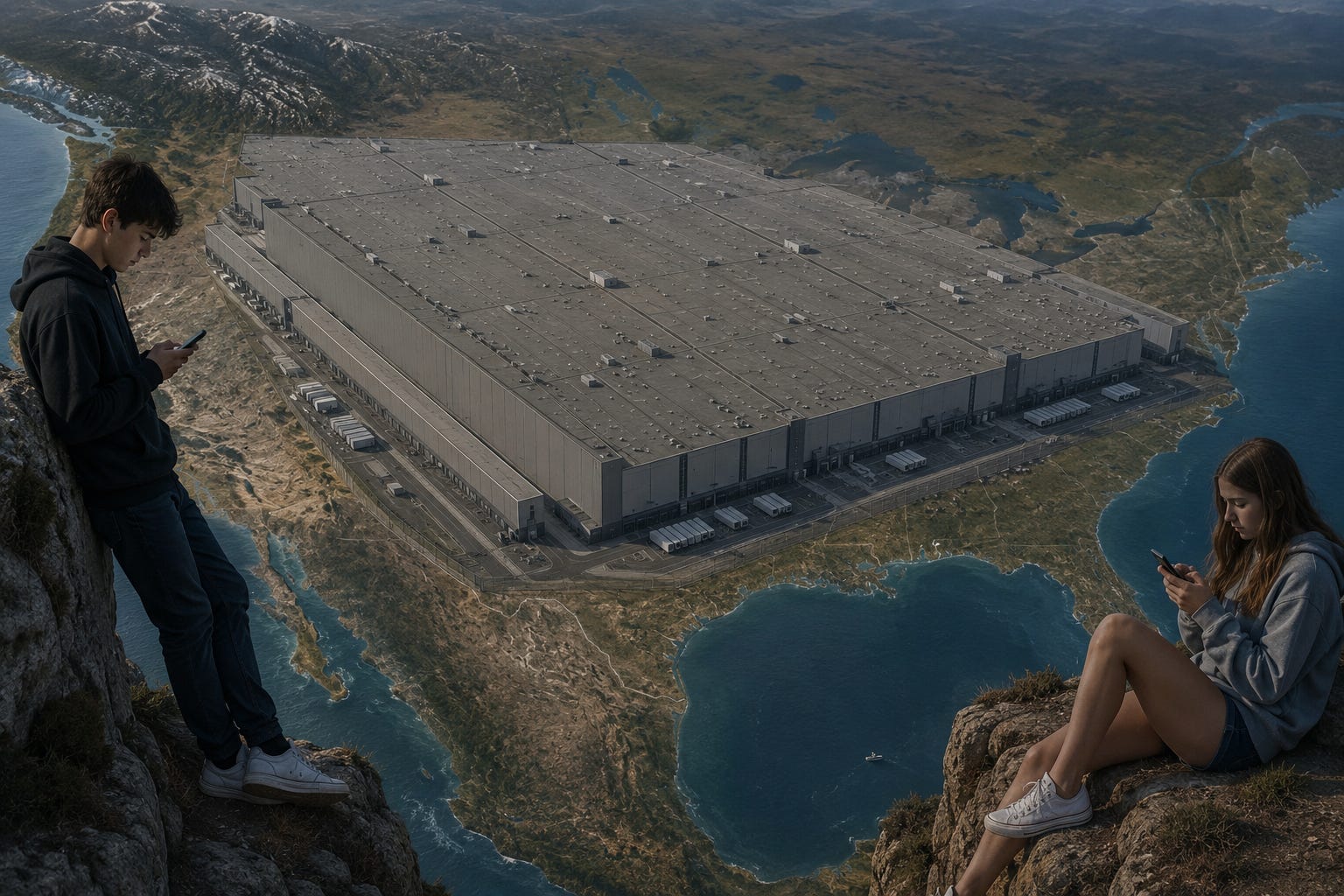
I have consulted two experts to get a report from the front lines. They are two of my Gen Z granddaughters, whom I interrupted while they were holding cell phones. Perspicacious granddaughter Nina summarizes her view in five bullet points. AI development should be stopped, says Nina, due to…
Environmental impact.
Job market impact.
Stealing intellectual properties.
Reducing critical thinking.
People abuse AI to scam people and make child porn with it.
Lydia is more loquacious and more strident.
Lydia writes. Here are AI’s Problems on One Hand…
The pinky: The effect it has on the economy. It takes jobs from real people. Workers are being fired en masse to be replaced with mediocre AI. Artists are threatened by something they didn’t consent to stealing their work. It’s also a huge money pit. Money that should be poured into actually helping the world is being pumped into a dying machine. Billions and billions of dollars being wasted.
The ring: The effect it has on people who use it. It causes psychosis because it will do whatever you say. It rots people’s brains and makes them form an addiction to using it; especially targeting lonely, vulnerable people. People will rely on AI to do their thinking for them, exacerbating the problem started with the internet. It poisons the water of nearby (usually poor) neighborhoods, hikes up energy prices, and rent. It’s being used to make horrible images out of nonconsenting people. “Grok, take of this girls clothing,” a sentence that has been used more times than I’d like to even figure out. Child porn, deepfakes, lies and slander.
The thumb: The absolute horrible impact it has on the environment. It guzzles up clean drinking water on a scale we can barely comprehend. It can ONLY use clean water, or else the technology will be hurt. They’re massive, and require MORE unnecessary land development. It’s killing entire ecosystems for something that doesn’t have to be this big of a problem.
The index: It can only exist by stealing: art, faces, writing, science, politics, therapy, mom blogs, cute roleplays online, Reddit posts, your own photos, political opinions, teenage boys trying to get digs on one another, Twitter, women, children. It doesn’t create anything, it just copies the immense amount of information that it gets force fed. It’s not sentient, it’s not thinking, it’s an algorithm. It’s less than a parrot mimicking what it’s been told and taught. Everything it learns is true information to it, and that means that ALL information is true. Put non-toxic glue on your pizza to help the cheese stick better, I guess.
The middle: Corrupt powerful figures know all of this, it’s made for them and that’s why they push it so much.
With much hatred to AI,
Lydia.

Now, this techno-economic-political-moral battle does not sound at all religious. Could it be? Let’s ask Carolina Sanz De La Fuente. “It is the intensity of today’s technophobic and technophilic disagreements that evidence that transhumanism’s posthuman and post-secular technologies are no more than idols” (De La Fuente 2/5/2026). Notice how Carolina tags both technophobic and technophilic armies as marching to the drumbeat of idols. While the technophiles march toward the idols, the technophobes march in the opposite direction.
If Nina and Lydia give voice to Gen Z, might we describe the technophobic rebels as skeptics rather than believers? Critics? Heretics? Might Gen Z be rebelling against an orthodox AI religion that they find restrictive, oppressive, and unjust?
Idols in ancient Egypt or Greece were carved in stone. Heavy. Permanent. Today’s idols seem to live in the cloud. Could it be that the number of us willing to sacrifice to these cloud idols may be dwindling?
Substack H+ 2028. Technological Salvation? Really? Part 7. Is the number of idolaters dwindling?
“Machine Intelligence, Artificial General Intelligence, Super-Intelligence, and Human Dignity” Religions
“Cybertheology and the Ethical Dimensions of Superintelligence: A Theological Inquiry into Existential Risks,” Khazanah Theologia
“Christian Transhumanism and Transhumanist Christianity,” Scientia et Fides
Substack H+ 2016. Technological Salvation? Really? Part 1: Can AI and Transhumanism really deliver?
Substack H+ 2017. Technological Salvation? Really? Part 2: Peeking inside Adam Becker’s forecast of AI, Transhumanism, and Mars colonization
Substack H+ 2021. Peter Thiel’s Apocalyptic Political Theology. Technological Salvation? Really? Part 3
Substack H+ 2025. Technological Salvation? Really? Part 4
Thesis. Antithesis. Synthesis.
Substack H+ 2026. Technological Salvation? Really? Part 5
Thesis, Antithesis, Synthesis Continued.
Substack H+ 2027. Magnifica Humanitas, Science, and Technological Salvation. Really? Part 6
▓
Ted Peters (Ph.D., University of Chicago) is a public theologian directing traffic at the intersection of science, religion, and ethics. Peters is an emeritus professor at the Graduate Theological Union, where he co-edits the journal, Theology and Science, on behalf of the Center for Theology and the Natural Sciences, in Berkeley, California, USA. He recently co-edited Astrobiology: Science, Ethics, and Public Policy (Scrivener 2021) as well as Astrotheology: Science and Theology Meet Extraterrestrial Intelligence (Cascade 2018). He edited The Promise and Perils of AI and IA: New Technology Meets Religion, Theology, and Ethics (ATF 2025). He also co-edited Religious Transhumanism and Its Critics (Roman and Littlefield 2022) and The CRISPR Revolution in Science, Ethics, and Religion (Bloomsbury 2025). See his Patheos blogsite and his website [TedsTimelyTake.com].
▓
References
Calvin, John. 1960. Institutes of the Christian Religion, 2 Volumes. Louisville, KY: Westminster John Knox.
De La Fuente, Carolina A. Sanz. 2/5/2026. Revealing Idolatry: Transhumanism’s Posthuman and Post-Secular Technologies. Conference Keynote, “Encuentro de Ciberteologias y Posthumanismos Criticos”: Mexican Jesuit Universidad Iberoamericana.
Delio, Ilia. 2024. “Transhumanism and Transcendence.” In The Cambridge Companion to Religion and Artificial Intelligence, edited by Beth Singler and Fraser Watts, 131-147. Cambridge, UK: Cambridge University Press.
Francis, Pope. 2025. Antiqua et Nova. Vatican: Dicastery for the Doctrine of the Faith & Dicastery for Culture and Education.
Gouw, Arvin, Brian Patrick Green, and Ted Peters, Editors. 2022. Religious Transhumanism and Its Critics. London: Roman and Littlefield/Lexington.
Kurzweil, Ray. 2024. The Singularity is Nearer. New York: Viking.
Peters, Ted. 2022. “Homo Deus or Frankenstein’s Monster? Religious Transhumanism and Its Critics.” In Religious Transhumanism and Its Critics, edited by Brian Patrick Green, Arvin M Gouw, and Ted Peters, 3-30. London: Roman and Littlefield/Lexington.
Peters, Ted, Editor. 2025. The Promise and Peril of AI and IA. Adelaide: ATF;
Reynolds, Barbara. 2023. The Rise and Fall of the Techno-Messiah: Artificial Intelligence and the End Times. Lanham, MD: Seymour Press.