

Technological Salvation? Really? Part 4
Thesis. Antithesis. Synthesis.

The Techo-Messiah will save us? Really?
In this series on technological salvation — salvation as found in the promises of AI (Artificial Intelligence), IA (Intelligence Amplification), and H+ (Humanity Plus or Transhumanism) — the question of idolatry arises frequently. Should we put our trust in technoscience? God? Both?
Technoscientific soteriology represents an adolescent ideology born from the marriage of divine providence with technological progress. But now, in a subsequent generation, the child is asking: “Who needs divine providence anymore when we can rely on Silicon Valley? Might a single-parent family be better?” Technoscience alone can deliver where religion only promises.” Youthful progress seems to be running away from home.
In this Patheos and Substack series, I have been asking: Will H+’s post-Singularity post-Human be a god or an idol? A Titan becoming a god, answers Harvard sociobiologist Edward O. Wilson. Like Prometheus stealing fire from the Olympian deities, today’s technoscience will steal the creative power of evolution from nature. “We are about to abandon natural selection, the process that created us, in order to direct our own evolution by volitional selection--the process of redesigning our biology and human nature as we wish them to be” (Wilson 2014, 14). Really?
How can we get a handle on this?
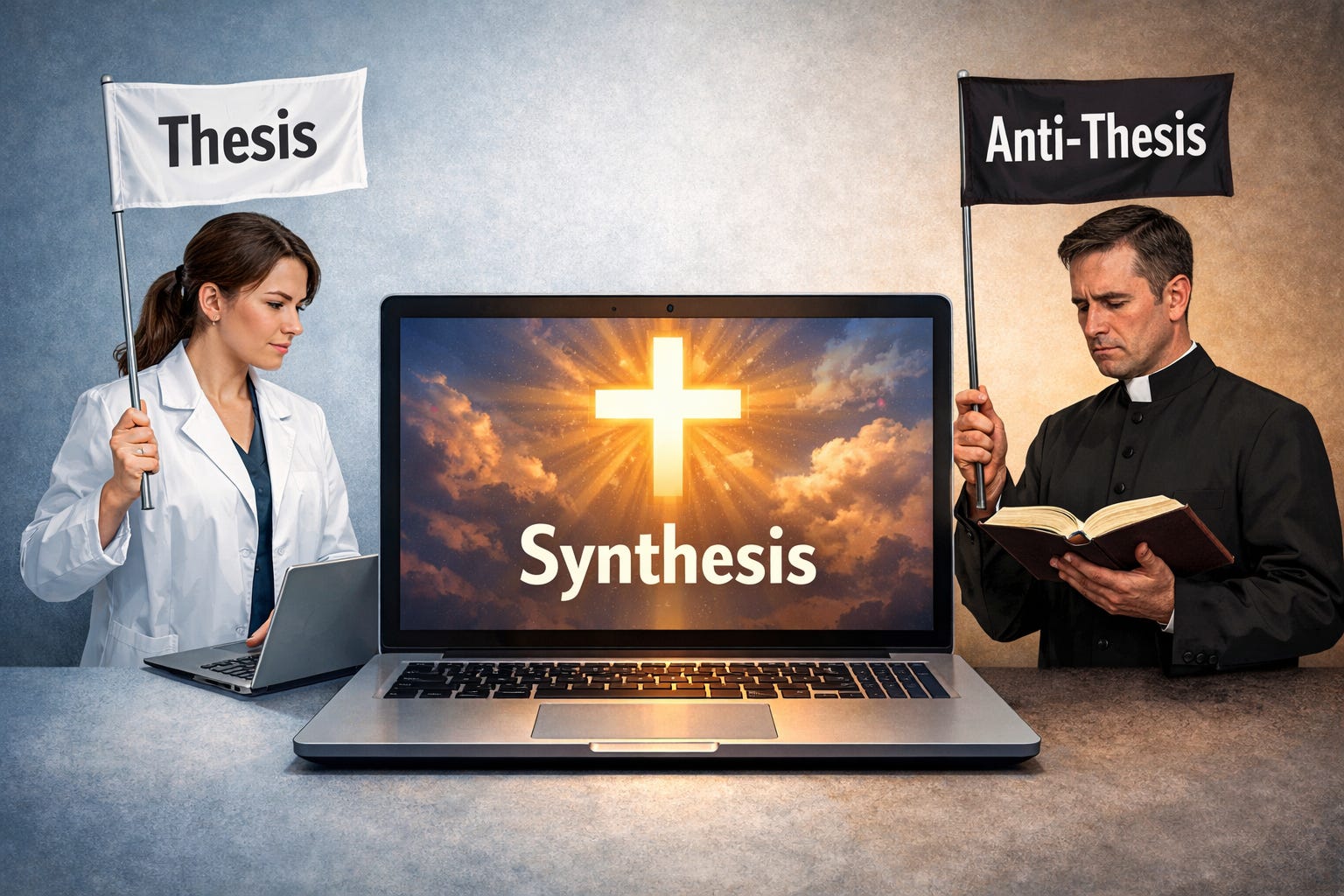
Thesis. Antithesis. Synthesis.
Let’s borrow from Hegel’s trialectic – thesis, antithesis, synthesis – to remind ourselves of the players in the technoscience salvation game.
Thesis. Powerful AI will bring utopia. More. Transhumanism will make immortality possible. In either its secular-atheistic form or in its overtly religious form, our advance to Superintelligence will cross the Singularity threshold and evolve us into the Posthuman, where we’ll experience the equivalent of apotheosis. Might traditionally religious people buy this product?
Antithesis. The antithesis derives from tralatitious religious believers who feel that we are being tempted by idolatry. Despite its promises, technoscience cannot deliver utopia, let alone everlasting life. This Promethean scenario tempts us to play God, to replace God with human achievement. It risks the loss of the human soul to an idol. The antithesis calls us to repent and return to the classical biblical promises of divine grace.
Synthesis. Synthetic theologians are subtle. They follow what I might dub the stewardship bridge between faith and technoscience. Because co-creativity and technological prowess are God’s gifts to the human race, we created co-creators are enjoined by God to use technoscience positively for God’s purposes. AI, IA, and even H+ can be tools, so to speak, with which we build our ministry to the world and with which we become virtuous witnesses to divine love and grace.
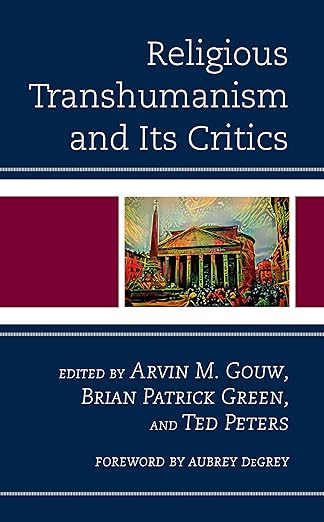
Along with two of my colleagues, Arvin Gouw and Brian Patrick Green, I spent a decade-plus interacting and partnering with our transhumanist friends in the San Francisco Bay Area. A few years ago, the three of us put together an anthology of essays that attempted to sort this out, Religious Transhumanism and its Critics (Gouw and Brian Patrick Green and Ted Peters 2022). We need continuous updates.
Thesis
The H+ thesis is that powerful AI will bring us utopia, and transhumanism will provide us with everlasting life.
Dario Amodei, CEO of Anthropic, throws open the gates of a utopian city on a hill in his 2024 article, “Machines of Loving Grace: How AI Could Transform the World for the Better.” Powerful AI will raise our experience of living as a human being with dramatic healings in biological health, mental acuity, economic development, government-insured peace, and meaningful work. Oh, yes, we will have to cooperate with AI and sideline bad actors. But a much better world could be in the making in less than a decade.
Dario Amodei writes. If all of this really does happen over 5 to 10 years—the defeat of most diseases, the growth in biological and cognitive freedom, the lifting of billions of people out of poverty to share in the new technologies, a renaissance of liberal democracy and human rights—I suspect everyone watching it will be surprised by the effect it has on them. I don’t mean the experience of personally benefiting from all the new technologies, although that will certainly be amazing. I mean the experience of watching a long-held set of ideals materialize in front of us all at once. I think many will be literally moved to tears by it.
Here is a postscript. In January 2026, Dario Amodei provided a follow-up disquistion, “The Adolescence of Technology: Confronting and Overcoming the Risks of Powerful AI.” The prospects of what might go wrong with AI border on the terrifying, even though Amodei assures us that we will be able to manage the risks. Amodei provides us with the utopian thesis and then, in turn, with the warnings that belong to the antithesis.
Now to transhumanism, the way station on the way to the posthuman. As a species, a posthuman utopia is just around the corner. Individually, AI technology will lead to Superintelligence either in a computer or in a human brain enhanced by a computer. We will gain immortality either through genetic enhancement leading to indefinite embodied longevity or, via uploading our mind to the computer cloud, disembodied cybernetic immortality. This will make the current generation of human beings obsolete. Obsolete Homo sapiens will either be enhanced or be evolutionarily advanced into the posthuman.
Secular or even atheistic transhumanists recognize that, like Prometheus in the ancient Greek myth, they will be stealing a power that previously had belonged to the gods. Do transhumanists fear playing God? By no means.
The Transhumanist Manifesto claims that “I am the architect of my existence,” not God. This eliminates any trepidation before the divine, at least according to Simon Young. “Let us have no irrational fears about ‘playing God’” (Young 2006, 49).
Playing God when redesigning humanity leads to an ethics dubbed EA (Effective Altruism). EA “preaches making the world a better place and doing it with rigorous logic, being disciplined enough to focus on the far future instead of the present, and fervently embracing the principles of capitalism and libertarianism—all in the name of morality” (Hao 2025, 228).
Might traditionally religious people be attracted to H+ soteriology and ethics? A few are. James Hughes, for example, welcomes the secular agenda of H+ into his Unitarian Universalist spirituality. “Cultivating self-transcendence without reliance on the supernatural is the shared aim of both the secular transhumanist movement and Unitarian Universalist spirituality” (Hughes 2022, 87).
Similarly, Michael LaTorra conscripts H+ technology into his Buddhist spirituality. “Buddhism and Transhumanism have many shared goals. Both seek to improve the communal and individual circumstances of human life, to remove the causes of suffering, and to raise humanity to a higher state of being” (LaTorra 2022, 81).

Perhaps the most complex and sophisticated of religious transhumanisms is that of the Mormon Transhumanist Association. Here is theologian Lincoln Cannon.
“Mormon transhumanism stands for the idea that humanity should learn how to be God, and not just any kind of god, not a god that would raise itself in hubris above others, but rather the God that would raise each other together as compassionate creators” (Cannon 2022, 53-54).
Could we imagine an Islamic Transhumanism? Only with severe qualifications. Oxford doctoral student, Tamim Mobayed, tenders a timid condition for Islamic Transhumanism.
“While the modern movement towards transhumanism aims to improve sensory perception by way of scientific intervention, Islamic transhumanism calls on believers to improve and purify their perceptions by way of God-consciousness, brought about increasing in remembrance of God. It might be argued that a Muslim’s transhumanist goals are directly tied to their devotion to God, rather than mastery of secular science. This difference embodies the fundamental difference between an Islamic transhumanism and secular transhumanism” (Mobayed 2017).
In sum, H+ calls upon assumed potentials within our evolutionary inheritance to be actualized through technoscience. And technoscience will lead us from humanity to posthumanity. That posthumanity will enjoy individual immortality and social utopia.
Transition
We will end this post with the Thesis. For the Antithesis and Synthesis, please proceed to the subsequent post, “Substack H+ 2026. Technological Salvation? Really? Part 5. Thesis, Antithesis, Synthesis, Continued.”
Substack H+ 2025. Technological Salvation? Really? Part 4. Thesis. Antithesis. Synthesis.
“Machine Intelligence, Artificial General Intelligence, Super-Intelligence, and Human Dignity” Religions
“Cybertheology and the Ethical Dimensions of Superintelligence: A Theological Inquiry into Existential Risks,” Khazanah Theologia
“Christian Transhumanism and Transhumanist Christianity,” Scientia et Fides
Substack H+ 2016. Technological Salvation? Really? Part 1: Can AI and Transhumanism really deliver?
Substack H+ 2017. Technological Salvation? Really? Part 2: Peeking inside Adam Becker’s forecast of AI, Transhumanism, and Mars colonization
Substack H+ 2019. Superintelligence? No, say our AI techies.
Substack H+ 2020. AI Ethics at the Vatican: Jews’ and Christians’ “Joint Statement on AI Ethics”
Substack H+ 2021. Peter Thiel’s Apocalyptic Political Theology. Technological Salvation? Really? Part 3
Patheos H+ 2022. AI and Public Theology
Substack H+ 2023. How can AI make us truly human? Urian Kim on Co-Creativity and Moral Responsibility
Substack H+ 2024 Crustafarian Claw Theology. AI and the Church of Molt.
Substack H+ 2025. Technological Salvation? Really? Part 4. Thesis. Antithesis. Synthesis.
Substack H+ 2026. Technological Salvation? Really? Part 5. Thesis, Antithesis, Synthesis, Continued.
▓
Ted Peters (Ph.D., University of Chicago) is a public theologian directing traffic at the intersection of science, religion, and ethics. Peters is an emeritus professor at the Graduate Theological Union, where he co-edits the journal, Theology and Science, on behalf of the Center for Theology and the Natural Sciences, in Berkeley, California, USA. He recently co-edited Astrobiology: Science, Ethics, and Public Policy (Scrivener 2021) as well as Astrotheology: Science and Theology Meet Extraterrestrial Intelligence (Cascade 2018). He edited The Promise and Perils of AI and IA: New Technology Meets Religion, Theology, and Ethics (ATF 2025). He also co-edited Religious Transhumanism and Its Critics (Roman and Littlefield 2022) and The CRISPR Revolution in Science, Ethics, and Religion (Bloomsbury 2025). See his Patheos blogsite and his website [TedsTimelyTake.com].
▓
References
Cannon, Lincoln. 2022. “Mormon Transhumanism.” In Religious Transhumanism and Its Critics, by Arvin M Gouw, Brian Patrick Green, and Ted Peters, eds, 53-74. Lanham MD: Lexington.
De La Fuente, Carolina A. Sanz. 2/5/2026. Revealing Idolatry: Transhumanism’s Posthuman and Post-Secular Technologies. Conference Keynote, “Encuentro de Ciberteologias y Posthumanismos Criticos”: Mexican Jesuit Universidad Iberoamericana.
Gallaher, Brandon. 2022. “Technological Theosis? An Eastern Orthdodox Critique of Religious Transhumanism.” In Religious Transhumanism and Its Critics, by Arvin M Gouw, Brian Patrick Green, and Ted Peters, eds, 161-182. Lanham MD: Lexington.
Gouw, Arvin. 2022. “Epilogue: Introducing a New Transhumanist Theology.” In Religious Transhumanism and Its Critics, by Arvin M Gouw, Brian Patrick Green, and Ted Peters, eds, 409-424. Lanham MD: Lexington.
Gouw, Arvin M. 2024. “Undisciplining the Science and Religion Discourse on the Holy War on Obesity.” Religions 15:12 https://doi.org/10.3390/rel15121538.
Green, Brian Patrick. 2022. “A Roman Catholic View: Technological Progress? Yes. Transhumanism? No.” In Religious Transhumanism and Its Critics, by Arvin M Gouw, Brian Patrick Green, and Ted Peters, eds, 143-160. Lanham MD: Lexington.
Hao, Karen. 2025. Empire of AI. New York: Penguin.
Hughes, James. 2022. “Unitarian Universalists as Critical Transhumanists.” In Religious Transhumanism and Its Critics, by Arvin M Gouw, Brian Patrick Green, and Ted Peters, eds, 87-100. Lanham MD: Lexington.
LaBerge, Carmen F. 2019. “Christian Transhumanism? A Christian Primer for Engaging Transhumanism.” In The Transhumanism Handbook, by ed Newton Lee, 771-776. Heidelberg: Springer.
LaTorra, Michael. 2022. “Pre-Original Buddhism and the Transhumanist Imperative.” In Religious Transhumanism and Its Critics, by Arvin M Gouw, Brian Patrick Green, and Ted Peters, eds, 75-86. Lanham MD: Lexington.
Mobayed, Tamim. 2017. “Immortality on Earth? Transhumanism Through Islamic Lenses.” Yaqeen, Dec 11.
Oviedo, Luis. 2025. “Present and (potential) future trends in science, religion and theology .” Reviews in Science, Religion, and Theology 4:2 56-60.
Peters, Ted. 2022. “Homo Deus or Frankenstein’s Monster? Religious Transhumanism and Its Critics.” In Religious Transhumanism and Its Critics, by Arvin M Gouw, Brian Patrick Green, and Ted Peters, eds, 3-30. Lanham MD: Lexington.
Peters, Ted. 2025. The Promise and Peril of AI and IA. Adelaide: ATF.
Redding, Micah. 2022. “Why Christian Transhumanism?” In Religious Transhumanism and Its Critics, by Arvin M Gouw, Brian Patrick Green, and Ted Peters, eds, 113-128. Lanham MD: Lexington.
Tirosch-Samuelson, Hava. 2022. “The Transhumanist Pied Pipers: A Jewish Caution against False Messianism.” In Religious Transhumanism and its Critics, by Arvin M Gouw, Brian Patrick Green, Ted Peters and eds, 183-214. Lanham MD: Lexington.
Wilson, E O. 2014. The Meaning of Human Existence. London: W. W. Norton.
Young, Simon. 2006. Designer Evolution: A Transhumanist Manifesto. Amherst NY: Prometheus Books.