

Scapegoating Satan? Poor Satan.
Eric Sias on the Bible in Secular Discourse.

Substack ST 2175. Scapegoating Satan? Poor Satan. Eric Sias on the Bible in Secular Discourse.
Have you ever felt pity for Satan? After all, we certainly mistreat him. We scapegoat Satan by blaming our sins on him. Poor Satan.
Just how should we think about this? Let’s ask biblical scholar Eric Sias.
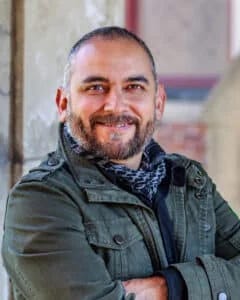
Meet Professor Eric Sias
Meet Eric Sias. Dr. Sias is Associate Professor of Biblical Studies as well as Director of Latina/o Programs at the Berkeley School of Theology in Berkeley, California. One of his hermeneutical concerns is the role of biblical language – what I call “biblical symbols” – in contemporary secular discourse. Sias does not like what he hears and sees. He’s critical. He notices how Christian symbols of evil can themselves do the work of evil. They can serve to marginalize, discriminate, and victimize.
Here’s the point: a biblical symbol of evil can itself contribute to evil. Really? Yes, indeed.
Hermeneutics and the Symbolism of Evil
The Symbolism of Evil is a book authored by hermeneutical philosopher Paul Ricoeur (1913-2005), one of my professors in an earlier generation (Ricoeur 1967). It was my good fortune that Ricoeur left his position as Chair of Philosophy at the Sorbonne in Paris to finish his teaching career at the University of Chicago. There, at Chicago, I could study with him. Am I ever appreciative!
Ricoeur introduced me to the multi-valent dynamics of powerful symbols, which may go unnoticed while they do their contemporary work as influencers. Through the hermeneutic of suspicion, as Ricoeur described it, clever scholars could uncover hidden yet influential meanings.
Another French scholar who has similarly influenced me is René Girard (1923-2015), literary critic and anthropologist at Stanford who developed key concepts such as mimetic theory and the scapegoat mechanism (Girard 2002). The particular problem Sias discerns in current discourse is illuminated by the scapegoat mechanism as Girard describes it. I like what Sias does here.
I like to call this form of hermeneutics discourse clarification, a task of the public theologian. Sias is a public theologian with a special interest in the biblical symbol, “Satan.”
At a recent meeting of the Pacific Coast Theological Society at Grace Cathedral in San Francisco on May 1, 2026, Sias gave us a most insightful analysis of the role of Satan in current public discourse. What does Sias say?
What would Christianity look like without Satan?
Eric Sias writes. What would Christianity look like without Satan? This question is not hypothetical. In the current American political landscape, the Satan figure has migrated almost entirely out of the theological conversation and into the political sphere. He shows up in campaign speeches, in viral videos, and Sunday sermons that sound more like political rallies than proclamations of the gospel. And what is troubling is not that people outside the church are doing this, but that those on the inside are, with extreme theological confidence and almost no awareness that they are reproducing a very old and dangerous pattern.
Now, I want to be clear about what I mean, because the question sounds more provocative than I intend it. I am not asking whether worldly evil, suffering, or injustice is real. Obviously, it is. What I am asking is a hermeneutical, or more specifically, a reception-based question: what happens when the figure of Satan — whose origins in the Hebrew Bible are far more modest than popular usage suggests, where śāṭān simply means “adversary” — gets detached from its literary and historical contexts and becomes a free-floating figure up for political grabs?
In my own research, I have traced that trajectory in detail (Sias 2023). The Satan figure developed gradually, shaped by the pressures of exile, crisis, and apocalyptic expectation. And what René Girard helps us see, in The Scapegoat, is that this trajectory is not accidental.
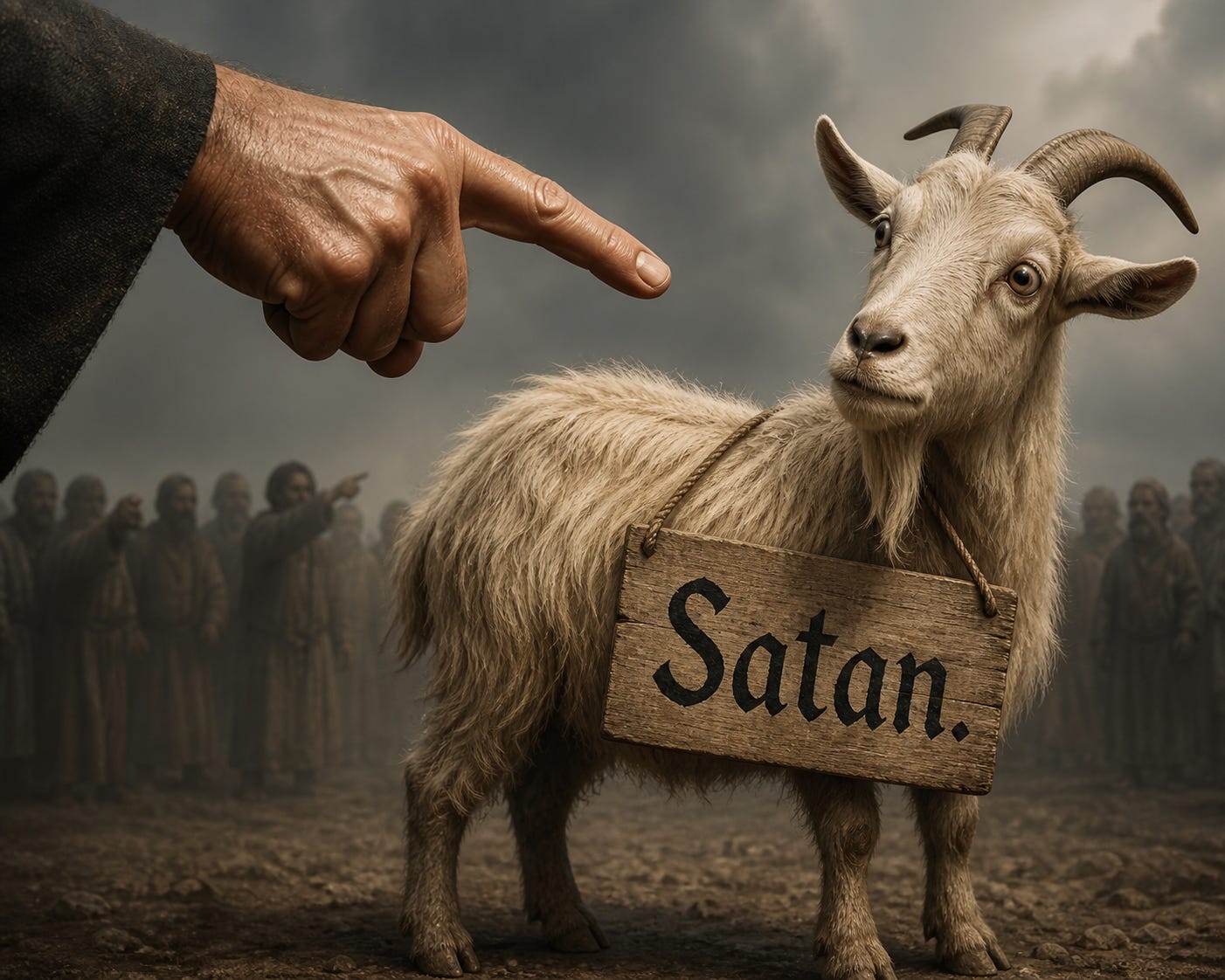
Girard demonstrates that what communities reliably do in moments of social crisis is reach for a victim — someone to carry the disorder, to bear the blame, and be expelled so that the group can reunify around the scapegoat’s elimination.
And what makes his analysis so useful here is Girard’s insistence that the kingdom of Satan, in the Gospel’s own language, names precisely this dynamic: the idea of violent expulsion through sacrifice and othering so communities maintain themselves. And within our current context, the scapegoat mechanism is something many Christian communities have found themselves reproducing from within, often without recognizing it.
This is where I find myself wanting to extend Ted Peters’ project. Peters calls for discourse clarification as a primary tactic of the public theologian — exposing the self-justifications and mechanisms by which injustice hides behind the language of virtue. I find this point prophetic. What I want to add, however, as a biblical scholar, is that this work of clarification has to begin hermeneutically (since the Bible is the foundation of theology). It has to begin with honest attention to how biblical texts are actually functioning in public life — not just in idealized form, as sources of wisdom for the common good, but in their actual reception, where they are often functioning in ways that are quite different.
Today’s Meaning of an Ancient Text
Eric Sias writes. This is the challenge Walter Wink (1935-2012) pressed on biblical scholarship years ago. In his critique of the historical-critical paradigm, Wink observed that academic biblical interpretation, for all its genuine achievements, tends to place the objective meaning of a text firmly in its ancient context — and in doing so, loses traction on what the text is doing in the reader’s present reality.
The result is a generation of scholars equipped to explain the historical development of the Satan figure within the biblical narrative — and to explain it well — but whose explanations rarely impact or even reach the communities most vulnerable to decontextualized readings of those same texts. Meanwhile, dubious interpretations spread like wildfire through popular media, precisely because they are emotionally gripping and narratively simple.
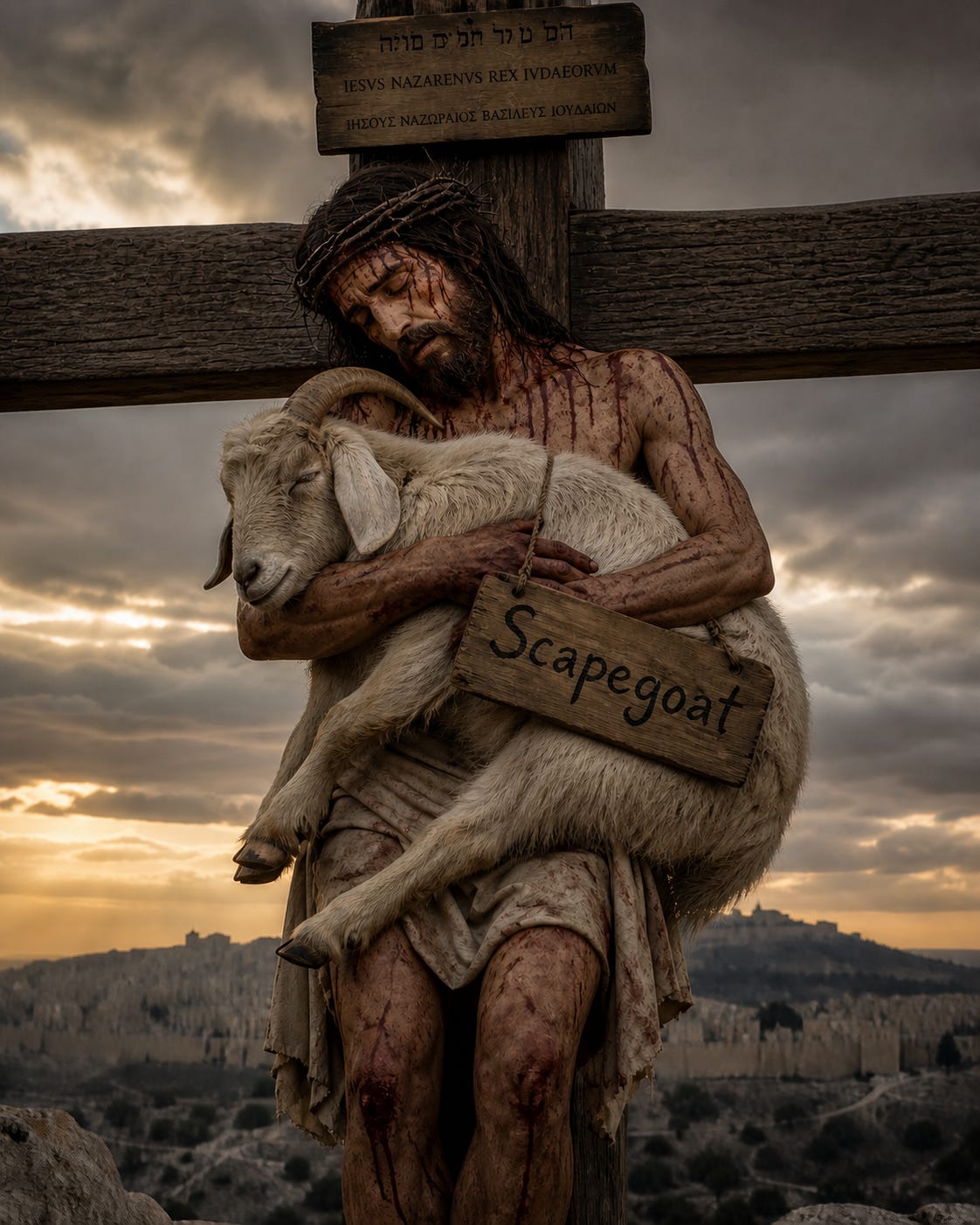
Girard’s reading of the Passion narrative is instructive here. He notes that the Gospels do something unusual in ancient literature: they tell the story of collective violence from the victim’s perspective rather than the crowd’s. They refuse to let the scapegoat mechanism pass unnoticed. The words from the cross in Luke — “Father, forgive them, for they know not what they do” — are not, for Girard, merely a statement of benevolence but the very diagnosis we are talking about: the crowd does not know what it is doing. Thus, the mechanism is unconscious, and that is exactly the point. And the Gospel’s work is to make that ignorance visible.
Critical Hermeneutics in Discourse Clarification
Eric Sias Writes. That, I would suggest, is still our work. What the Gospels model, in other words, is exactly what I am calling critical hermeneutics — the willingness to read against the crowd, to refuse the comfort of the scapegoating narrative, and to insist that the text has something harder and more honest to say than what fear and power want it to say. And it belongs, I would argue, especially to those of us trained to read carefully, historically, and contextually — because we are among the few equipped to show the public not just what the Bible says, but what it has been made to say, and why that difference matters so much right now.
Peters is right that the public theologian must speak into the cacophony of the public square with a rational and prophetic voice. What I want to add is that the biblical scholar has a specific and irreplaceable contribution to make to that work. It is not primarily the work of translating theological doctrines into accessible public language. Rather, it is the harder and more urgent work of helping people understand that every reading of the Bible is located somewhere, that context shapes meaning, that authority and power are always at work in interpretation, and that when those dynamics go unchecked, sacred texts become weapons rather than sources of liberation.
The weaponization of biblical tropes that Peters and I both identify in this current American moment is not simply a problem of bad actors misreading good texts. It is a symptom of a public that has not been equipped to ask who is reading, from where, for whose benefit, and at whose expense. That is exactly the kind of critical, contextual, participatory engagement that biblical scholarship can offer the public square — not to tear down, but to clear ground for something more honest, more just, and more genuinely inclusive than what fear-driven interpretation has built.
Conclusion
Ted Peters writes. If in public discourse you or I call someone or some group “Satanic” or by innuendo identify them with evil, we are scapegoating them. We are justifying taking action against the scapegoats that will marginalize, expel, or even kill them. In a paradoxical sense, the word “Satan” casts out Satan and renders the one uttering the word “Satan” the real Satanic actor. Didja git that? Remember, Jesus tells us that Satan is the father of lies (John 8:44).
Here’s my point, and I think the point of Dr. Sias as well: inherited biblical language can be dangerous when it is employed within the scapegoat mechanism.
Note how Dr. Sias says that the powerful influence of biblical tropes or symbols in current discourse is “not simply a problem of bad actors misreading good texts.” I would add that biblical tropes and symbols are semi-visual ferries from the past, docked on the horizon of the unsaid – to borrow a term from the hermeneutical philosopher Hans-Georg Gadamer (1900-2002) – that come alive again at the contemporary ferry landing. But this is only a general observation on my part.
Sias follows a different route, a longer path aimed at healthy remediation. Sias tries to disarm the negative influence of ancient tropes and symbols in current discourse through context mitigation.
Sias wants the biblical hermeneut to ask critical questions that enhance our engagement with both the sacred text and the current context. He wants us “to ask who is reading, from where, for whose benefit, and at whose expense”? This means, I take it, that in biblical interpretation we empathetically identify with the impact the sacred text could have on the specific readers in each specific context. “That is exactly the kind of critical, contextual, participatory engagement that biblical scholarship can offer the public square.”
I ask: would this suffice to mitigate the negative impact of the scapegoat mechanism? It would if the biblical hermeneut would accompany word-analysis with empathy for the victims of scapegoating, with those wrongly dubbed to be Satanic. Such empathy for the victim would be the work of the symbol of the cross within discourse clarification.
Substack ST 2175. Scapegoating Satan? Poor Satan. Eric Sias on the Bible in Secular Discourse.
Patheos SIN 7 The true story of Satanic Panic
Patheos SIN 8 How can Satan cast out Satan?
Patheos SIN 9 Ted’s Tips on Satan and Demons
Patheos PT 3264. Do Scapegoats Purify America?
Substack PT 3283. Antisemitism and Scapegoat Confuzzlement
Substack ST 2174. Sin 24. Morally Bad Americans? Power, Self-Justification, and Scapegoating
Scapegoat Resources
▓
Meet Ted Peters. For Substack, Ted Peters posts articles and notices in the field of Public Theology. He is a pastor in the Evangelical Lutheran Church in America and an emeritus professor at Pacific Lutheran Theological Seminary and the Graduate Theological Union. His single-volume systematic theology, God—The World’s Future, is now in the 3rd edition. He has also authored God as Trinity plus Sin: Radical Evil in Soul and Society, as well as Sin Boldly: Justifying Faith for Fragile and Broken Souls. In 2023 he published, The Voice of Public Theology, with ATF Press. More recently, he has published an edited volume, Promise and Peril of AI and IA: New Technology Meets Religion, Theology, and Ethics (ATF 2025), and, along with Arvin Gouw, an edited collection, The CRISPR Revolution in Science, Religion, and Ethics (Bloomsbury 2025). Soon to be released is a volume of essays, A Handbook on Astrobiology, Astrotheology, and Astroanthropology, co-edited with Carolina Azucena Sanz de la Fuente and Arvin Gouw, with ATF.
See his website: TedsTimelyTake.com and Patheos blog site.
▓
References
Girard, René. 2002. The Girard Reader. New York: Crossroad.
Peters, Ted. 2018. “Religious Sacrifice, Social Scapegoating, and Self-Justification.” In Mimetic Theory and World Religions, edited by Wolfgang Palaver and Richard Schenk, 367-384. East Lansing, MI: Michigan State University Press.
Ricoeur, Paul. 1967. The Symbolism of Evil. Boston: Beacon.
Sias, Eric J. 2023. “The power of paranoia: Politics, the Bible, and conspiracy theories.” Review and Expositor 120:4 292-309. DOI: 10.1177/00346373241259953.