

Morally Bad Americans?
Power, Self-Justification, and Scapegoating

I like thinking that I’m a good guy. So, if I’m a good guy, then somebody else must be bad. Or, at least less good than I am. Who might that be? Might the morally bad people be Central American immigrants, whom our president calls “murderers” and “rapists” who are killing us with illegal drugs? Or, might the morally bad people be the MAGAs who are calling those poor immigrants morally bad? Or, might the morally bad people actually be my progressive friends who are calling my MAGA friends morally bad? Mmmm? I’m getting confused here.
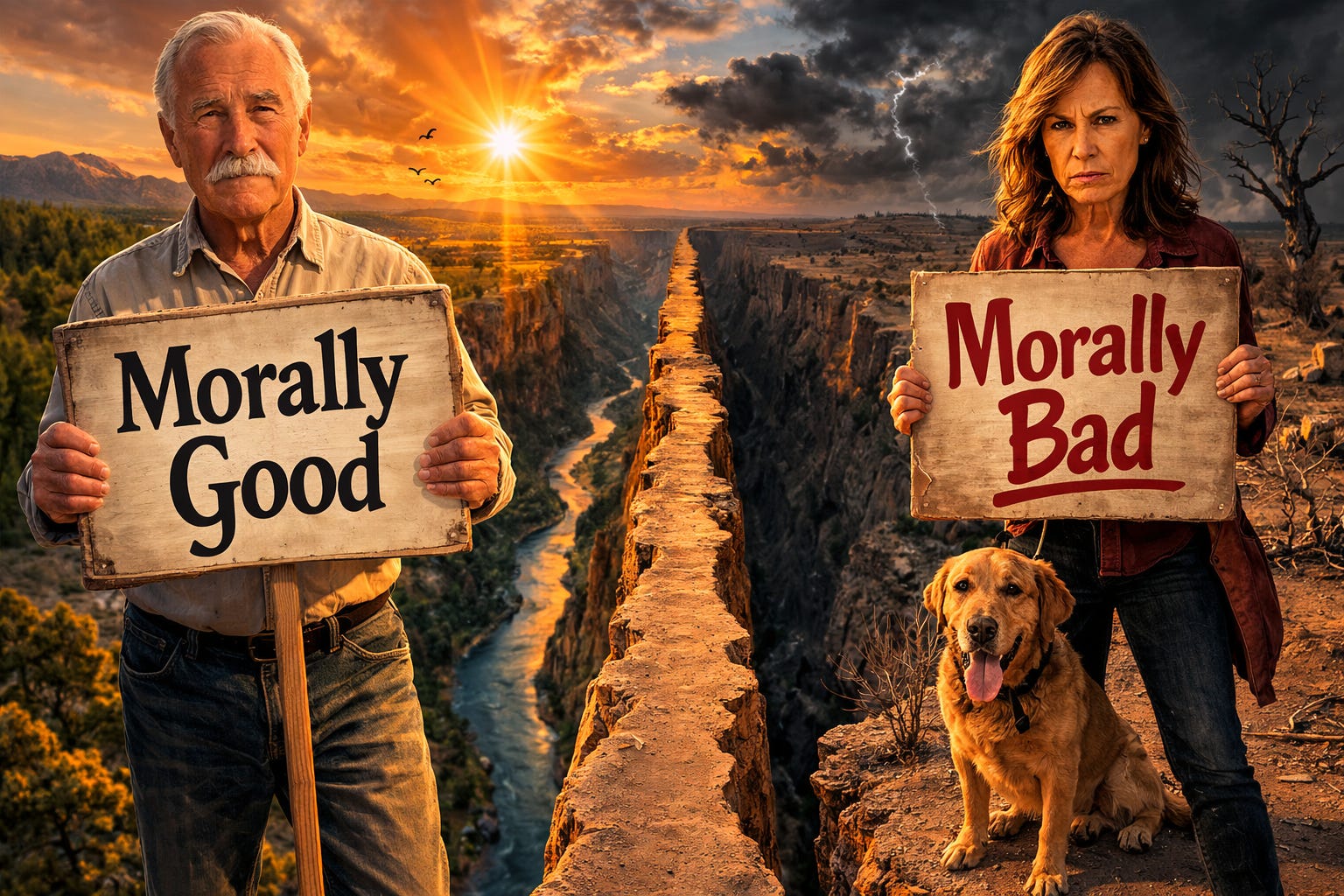
Who is morally bad?
“Morally Bad.” That’s a term used by the Pew Research Center. If you ask Americans about their neighbors, they are more likely to judge their neighbors as morally bad than morally good. According to Pew, 53% of those polled describe their neighbors as morally or ethically degenerate. Pew researchers note that the US is the only country tested in which this is the case. If it is objectively true that 53% of Americans are morally bad, then good Americans live next door to more bad people than those of other countries. Should we feel sorry for good Americans because they must live with so many bad ones? Should we recommend that Americans move to Canada or Indonesia, where 92% of the people are morally good?

Might it be political?
Pew refined their study a bit by asking about political affiliation.
Democrats and independents who lean toward the Democratic Party are much more likely than Republicans and Republican leaners to rate fellow Americans as morally and ethically bad (60% vs. 46%). And previous research has shown that rising numbers of both Republicans and Democrats say people in the other party are immoral.
Do the Democrats know something we need to learn? Is it really the case that Republicans are morally and ethically unprincipled? Or, could it be the reverse?
Might it be sin?
Let’s set aside the objective question: are 53% of Americans actually immoral? Instead, let's look at those who judge their neighbors to be immoral.
Jesus, you may recall, gave relatively little attention to immorality but a great deal of attention to hypocrisy. “Why do you look at the speck of sawdust in your brother’s eye and pay no attention to the plank in your own eye?” (Matthew 7:3). With precision targeting, Jesus aimed his pedagogical laser at those who judge others as immoral to cover up their own plans to do evil. Doing evil while looking good! That’s what we humans do, according to Jesus.
As a systematic theologian, I have tried to biopsy sin to see just what is so cancerous. Under the microscope, I think I perceive three toxic adulterants. Here is my three-part diagnosis.
First, coveting.
Of all the things you and I covet, what we want most is power. Our insatiable lust for wealth or fame or popularity expresses our inner craving to be strong. To be strong is to be secure. In some cases, we want to be strong enough to defy death.
Beating death and the pursuit of justice are connected, invisibly connected. Really?
What many theological researchers fail to see is the toxicity in our human drive to be good, right, and eternal. Secretly, we believe that justice and rightness and goodness are eternal. Therefore, our inner soul reasons, if we can be identified with the eternal, then we can beat death. So we covet power. When we covet power, we sometimes declare ourselves to be morally just out of the delusion that moral justice connects us with what is eternal.
Although it may not be obvious, I am saying this: when we invest ourselves in thinking of ourselves as just, we are coveting the power to beat death. Yep. Whether we think about it or just presuppose it, we believe justice and power belong together.
Second, self-justifying.
We covet being right, along with fancying that other people think of us as being fair or just, in such a way that we want to own this rightness or justice. It’s ours. We’ve earned it. And if it goes unnoticed, we are quick to state clearly so all can hear: “It wasn’t my fault!” “I didn’t do it!” “I always root for the underdog!” “I fight for freedom!” “We are bombing cities to liberate those people from tyranny!” “I stand for apple pie, motherhood, and the American way.” In short, we daily draw a line between good and evil. And we place ourselves on the good side.
Here is how it works. On February 28, 2026, a US Tomahawk missile struck a girls’ school in Minab, Tehran. The explosion killed 150 or more girls and their teachers. The bombing was recorded on video. As of this writing, no US official has taken responsibility for these deaths. POTUS told the press, “In my opinion and based on what I’ve seen, that was done by Iran…They’re very inaccurate, as you know, with their munitions.” Pentagon Pete said that the Pentagon was investigating, “but the only side that targets civilians is Iran.”
What is going on here? Take a close look. POTUS ‘n’ Pete draw a line between the morally good and the morally bad. They put themselves on the morally good side and the bombing victim, Iran, on the morally bad side. Because Iran is morally bad, America is justified in bombing. That’s how self-justifying and scapegoating work. POTUS ‘n’ Pentagon Pete are just and, hence, in a deluded way, eternal.

Third, scapegoating.
When we draw that line between good and evil and place ourselves on the good side, whom do we place on the evil side? Answer: the scapegoat. The scapegoat is the one we deem to be morally bad. Once we have convinced ourselves that our neighbor is morally bad, we are then justified in punishing that neighbor through gossip, rumor, sabotage, violence, or war.
For example, when the US government draws a line between good and evil, it places not just Iran but also immigrants on the evil side. Immigrants are said to be murderers, rapists, and drug traffickers. This justifies governmental policies that include raiding parties by masked law enforcement, denial of legal due process, incarceration in hastily built detention centers with insufficient food and water, and shooting to death American protestors who attempt to protect immigrants from government cruelty. Power. Self-justification. Scapegoating. Yep! That’s what public theologians call sin at the federal level.
Scapegoating God
The Christian gospel, according to this diagnosis, announces divine therapy for our sinful condition. On the cross, St. Paul attests, Jesus Christ took the place of the scapegoat. “God made him who had no sin to be sin for us, so that in him we might become the righteousness of God’ (2 Corinthians 5:21). Part of the gospel message is that, when God voluntarily took the place of those whom we scapegoat, God bequeathed to you and me divine rightness and divine justice. This means you and I no longer need to self-justify or scapegoat to make ourselves right or just or eternal. That’s grace at work.
They look and sound just like us
Joshua Mason is a police officer. He looks evil in the face every day. But he notices that evil does not look like evil. At least at first.
I entered law enforcement expecting to find the monsters described in crime novels — figures who radiated danger and stood out in a crowd. Instead, I found that the most devious people were often those who had mastered social etiquette. They look and sound exactly like us.
That’s right. Those morally bad people “look and sound exactly like us.” Discerning genuine evil on both sides of the line we draw takes some honest effort.
Conclusion
It appears that some among us — especially Americans who are now swept up in a moral pandemic — relish thinking of our neighbors as morally bad. We draw a line between good and evil and then place our neighbors — Iranians, immigrants, MAGA Republicans, progressive Democrats, and such — on the evil side of that line. This justifies us as being morally good while it justifies us when perpetrating violence against those who deserve our punishment.
According to my diagnosis, the disease here is commonly known as sin. According to Dr. Jesus, sin is a chronic malignancy with symptoms we observe every day. Among its comorbidities, we see and hear calumny, scapegoating, cruelty, violence, and war.
Now, it’s easy to become blind to sin. It’s easy to deny that we are infected. How do we engage in denial? It’s simple. Just draw a line between good and evil. Then, place someone you don’t like on the evil side. Label the evil side, “morally bad.”
Such denial feels almost as good as a cure. Right?
Substack ST 2174. Morally Bad Americans? Power, Self-Justification, and Scapegoating
SIN 1 Sin? Really?
SIN 2 Self-Justification
SIN 3 The Visible Scapegoat
SIN 4 The Invisible Scapegoat
SIN 5 Sin Boldly!
SIN 6 Sin and Grace
Substack ST 2173. Sin 23. Sin boldly! Really? How to face a moral dilemma
How does Jesus save? Part Seven: Final Scapegoat
▓
Ted Peters directs traffic at the intersection of science, religion, and ethics. Ted is an emeritus professor at the Graduate Theological Union, where he co-edits the journal, Theology and Science, with Robert John Russell on behalf of the Center for Theology and the Natural Sciences, in Berkeley, California, USA. He authored Playing God? Genetic Determinism and Human Freedom? (Routledge, 2nd ed., 2002) as well as Science, Theology, and Ethics (Ashgate 2003). Along with Martinez Hewlett, Joshua Moritz, and Robert John Russell, he co-edited Astrotheology: Science and Theology Meet Extraterrestrial Intelligence (2018). Along with Octavio Chon Torres, Joseph Seckbach, and Russell Gordon, he co-edited Astrobiology: Science, Ethics, and Public Policy (Scrivener 2021). Along with Arvin Gouw and Brian Patrick Green, he co-edited Religious Transhumanism and Its Critics (Lexington 2022). This year Ted edited The Promise and Peril of AI and IA: New Technology Meets Religion, Theology, and Ethics (ATF 2025) and co-edited with Arvin Gouw The CRISPR Revolution in Science, Religion, and Ethics (Bloomsbury, 2025).
His theme volume is The Voice of Public Theology, a collection of previous articles. See his website: TedsTimelyTake.com.
▓