
Is Oprah Winfrey Evolving After All?
On the Law of Increasing Functional Information (LIFI)

“I’m evolving every day,” says Oprah Winfrey. Kinda. The actual way she puts it is more inspiring. “The whole point of being alive is to evolve into the complete person you were intended to be.”
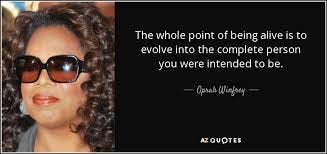
Now, in my opinion, Oprah embodies all that is best about American culture. She combines fame with humility, knowledge with beauty, and wisdom with grace. She is a person rightly admired in every quarter.
But Oprah does not evolve! Only biological species evolve. Individual people do not evolve. That’s what Charles Darwin said. And Darwin was right.
Did I get that right?
Maybe not. What if we apply LIFI to Oprah? What is LIFI? It’s the Law of Increasing Functional Information. An article in the July 8, 2023 Proceedings of the American Academy of Sciences, “On the roles of function and selection in evolving systems,” just might change my thinking about evolution.
This could be important for the field of Big History. Big historians want to fold into a single story of the universe both evolutionary history and human history set within the context of the universe’s history. Such a historical account is possible only if it is meaningful. Only if it incorporates a telos or entelechy (Peters 2017). Does Oprah get her own chapter in the Big History story of everything?
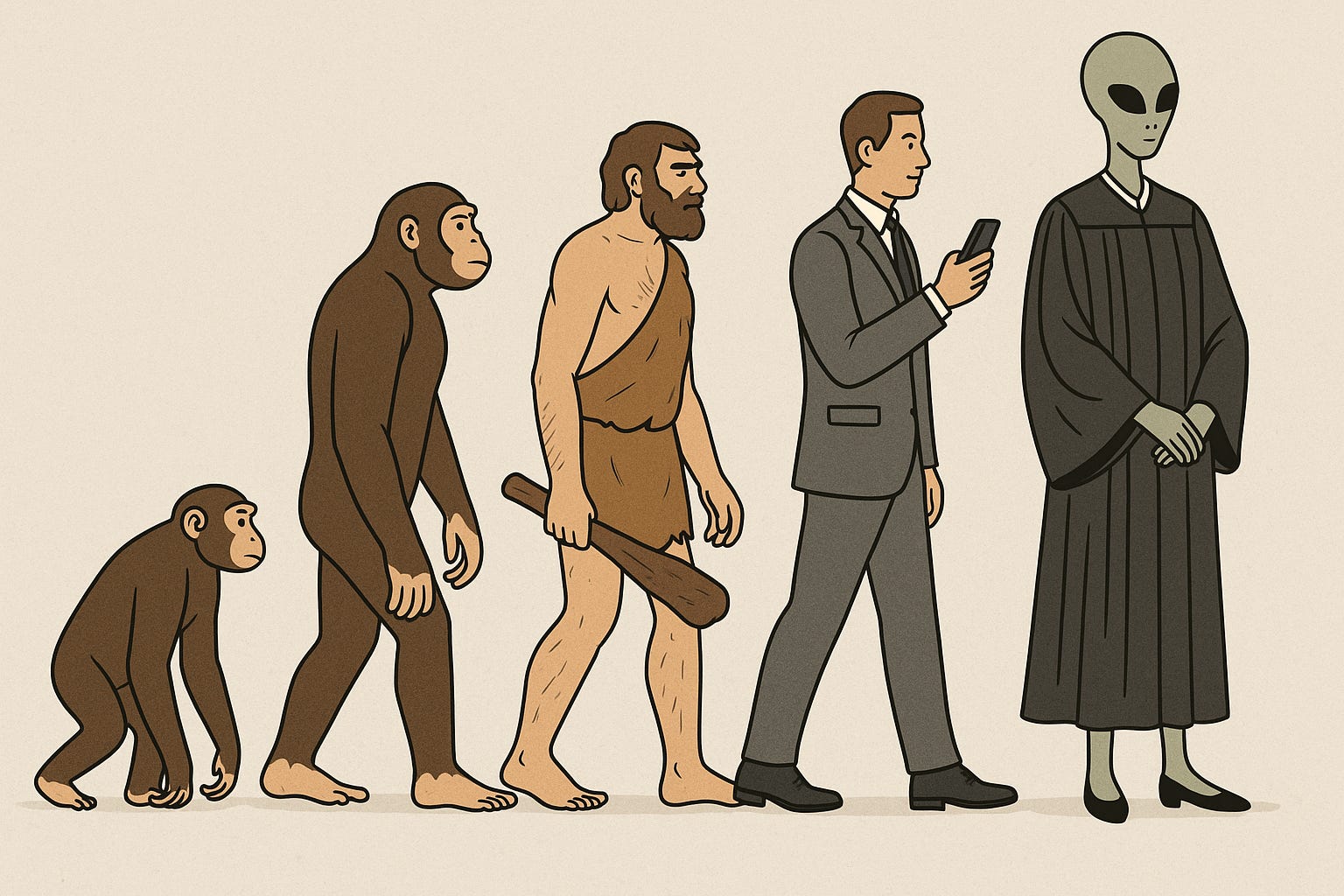
Remind me, what is evolution again?
Here is how I have been grasping the theory of evolution. Evolution means change. But not all change is evolution. What we call biological evolution refers specifically to Charles Darwin’s (1809–1882) theory originally put forth in his 1859 book, On the Origin of Species by Natural Selection. Note that Darwin’s title applies evolution to species, not to individuals. Note also that Darwin specified the means of evolution: natural selection.
Nature selects among our offspring which traits will survive and which will die out. Reproduction does not mean precise replication. What Darwin observed was inherited variation. Darwin observed that offspring produced by sexual reproduction differ slightly from their parents; but he had no scientific explanation for this difference.
By a quirk of history, a contemporary to Darwin, a monk named Gregor Mendel living in an Augustinian monastery in what is now the Czech Republic, discovered the role played by dominant and recessive alleles. He fromulated what we now know as the rules of Mendelian inheritance.
Having read Origin of Species, Mendel knew he could provide Darwin with an explanation for inherited variation. However, he was too shy to visit the exalted master of evolutionary theory in England and tender his genetic theory. Darwin went to his grave thinking this mystery was unsolved. The synthesis of Darwin and Mendel means this: natural selection determines which gene alleles go on to reproduce themselves and which go extinct. That’s where evolution takes place. Not in an individual’s life.
Since Darwin’s day, of course, science has advanced. It complemented Darwinian natural selection with additional processes such as horizontal gene transfer, genetic drift, and metapopulation dynamics.
Darwin used the term survival of the fittest (which was coined by Herbert Spencer) interchangeably with natural selection. The term fit here does not refer to traits such as strength or intelligence belonging to an individual. To be fit does not refer to brawn or brains. Rather, it refers solely to reproduction. To be fit is to reproduce, to pass one’s genes on to the next generation.
I stress here that the term survival of the fittest within evolutionary theory refers to one and only one kind of fitness: reproductive fitness. It does not describe physical traits such as strength, speed, or intelligence. To be fit means, in short, to make more babies that survive to make more babies.
Francisco Ayala: there is no evolutionary entelechy!
My friend, the late Francisco Ayala, former president of the AAAS and winner of the Presidential Medal for Science, said frequently: “After complex Homo Sapiens go extinct, the simpler cockroaches are likely to survive. Not because cockroaches are smarter. Rather, their genes better adapt to the formidable changes in Earth’s ecosphere.”
"This is Darwin's fundamental discovery, that there is a process that is creative though not conscious" (F. J. Ayala 2007, 202).
There is a corollary to what Ayala just averred: within evolutionary processes there is no grand telos, purpose, direction, or meaning. Only brute uncaring natural selection. Even though Nobel Prize winner Christian de Duve would say, “most likely, it [life] will continue to evolve toward greater complexity” (De Duve 1995, vii), Ayala would disagree. There is no inbuilt direction toward complexity or intelligence. The future of life may end up much simpler than it is today (Ayala 2017). “Evolution is a bumpy road to who knows where,” avers molecular biologist Carl Woese (Woese 2004, 180).
David Zielger articulates what is pretty much the standard position among scientists. "There are no long-range teleological trends or directions to evolutionary change; no goals of design, complexity, or intelligence are inherent in the evolutionary process" (Ziegler 2018, 42).
This position – evolution has no built in entelechy -- has been my summary of what scientists hold. But today I wonder. What about the law of increasing functional information (LIFI)? Might our colleagues in white lab coats sneak teleology back into evolution – even cosmic evolution – like a camel sneaks its nose under the tent flap?

The Law of Increasing Functional Information
Here is the law of increasing functional information.
The functional information of a system will increase (i.e., the system will evolve) if many different configurations of the system undergo selection for one or more functions (Wong, et al, 2023, 7).
This law is exemplified in stellar evolution, mineral evolution, and biological evolution.
These three evolving natural systems differ significantly in detail. Stellar nucleosynthesis depends on the selection of stable configurations of protons and neutrons. Mineral evolution relies on selection of new, locally stable arrangements of chemical elements. Biological evolution occurs through natural selection of advantageous heritable traits. Nevertheless, we conjecture that these examples (and many others) are conceptually equivalent … we contend that Darwinian natural selection and common descent are but one conceptually equivalent example of a far more general natural process (Wong, et al, 2023, 3).
Three functions apply to each of these three systems: stability, dynamics, and novelty. First, the most basic function is stability—stable arrangements of atoms or molecules are selected to continue. Second, dynamic systems with ongoing supplies of energy persist. The third function is novelty: the tendency of evolving systems to explore new configurations that sometimes lead to startling new behaviors or characteristics. Life's evolutionary history is rich with novelties. Photosynthesis evolved when single cells learned to harness light energy. Multicellular life evolved when cells learned to cooperate. Species evolved thanks to advantageous new behaviors such as swimming, walking, flying, and thinking.
Now, wait just a darned minute! Darwinian evolutionary theory – variation in inheritance acted on by natural selection – applies solely to biology and solely to species. What is all this about star formation and rocks?
According to the Carnegie Institution for Science, the law of increasing functional information complements the 2nd law of thermodynamics, which states that the entropy (disorder) of an isolated system increases over time (and heat always flows from hotter to colder objects). LIFI is not restricted to biology. It’s now physics and geology. Can this be correct? How can variation in inheriteance acted on by natural selection apply to stars and rocks?
I have my doubts about this proposal on another count. My own view is that stability, dynamics, and novelty are merely descriptors of what is observed. They are not laws. They describe but do not provide an explanatory account.
Despite my grumpy complaint, the central question is this: does “evolution” now apply to something other than biological speciation?
Conclusion
This discussion is important, I think, for big historians who set the human story within the framework of the cosmic story. Does LIFI have meaning for human existence as we experience it?
Back to Oprah. Do these three LIFI functions apply to her? First, Oprah exhibits stability. Her stream of consciousness has been stable since she was a little girl and will remain stable for the remainder of her life. Second, dynamics. Oprah exhibits energy, ambition, adaptation, and influence. Third, novelty. Of all Oprah’s virtues, she is clearly a creative person. Not only does she invent and reinvent herself, but she cajoles and encourages others to evolve into better persons. Does this mean Oprah – like stars, rocks, and species – fulfills these three functions?
Is Oprah Winfrey evolving every day after all?
Substack SR 5062 BH12 Is Oprah Winfrey evolving every day after all?
Patheos SR 5051 BH 1 Science, Religion, and Deep Time
Patheos SR 5052 BH 2 Science and Religion in Big History
Patheos SR 5053 BH 3 Teilhard and Big History
Patheos SR 5054 BH 4 What is history in Big History?
Patheos SR 5055 BH 5 God in Cosmic History
Patheos SR 5056 BH 6 Big History and Evangelical Theology: Roger Olson
Patheos SR 5058 BH 8 Big History, Religious Naturalism, and Ursula Goodenough
Patheos SR 5059 BH 9 Big History and Progressive Christianity: Thomas Lindell
Patheos SR 5060 BH 10 Critique of Ted Peters by Mitchell Diamond
Patheos SR 5061 BH11 Trinitarian Big History: Chris Barrigar

▓
Mehttp://publictheology.kr/main/bbs/content.php?co_id=s2_1et Ted Peters. Ted Peters pursues Public Theology at the intersection of science, religion, ethics, and public policy. Peters is an emeritus professor at the Graduate Theological Union, where he co-edits the journal, Theology and Science, on behalf of the Center for Theology and the Natural Sciences, in Berkeley, California, USA. His book, God in Cosmic History, traces the rise of the Axial religions 2500 years ago. He tackled the implications of genetic innovation for the future of humanity in Playing God? Genetic Determinism and Human Freedom? (Routledge, 2nd ed., 2002) as well as For the Love of Children: Genetic Technology and the Future of the Family (Westminster/John Knox 1997). His essays are collected in Science, Theology, and Ethics (Ashgate 2003) The Voice of Public Theology (ATF 2023).
Recently Ted edited The Promise and Peril if AI and IA: New Technology Meets Religion, Theology, and Ethics (ATF 2025). Along with Arvin Gouw and Brian Patrick Green, he co-edited the new book, Religious Transhumanism and Its Critics hot off the press (Roman and Littlefield/Lexington, 2022). His fictional spy thriller, Cyrus Twelve, follows the twists and turns of a transhumanist plot.
Visit Ted Peters’ website, TedsTimelyTake.com.
▓
References
Ayala, Francisco J. 2007. Darwin's Gift to Science and Religion. Washington DC: Joseph Henry Press ISBN978-0-309-10231-5.
Ayala, Francisco J. 2017. "Human Evolution and Progress." In On Human Nature: Biology, Psychology, Ethics, Politics, and Religion, edited by Michel Tibayrenc and Francisco J. Ayala, 565-575. Amsterdam: Elsevier.
De Duve, Christian. 1995. Vital Dust: The Origin and Evolution of Life on Earth. New York: Basic Books.
Peters, Ted. 2017. God in Cosmic History: Where Science and Big History Meet Religion. Winona MN: Anselm Academic ISBN 978-1-59982-813-8.
Woese, Carl R. 2004. "A New Biology for a New Century." Microbiology and Molecular Bilogy Reviews 68:2 173-186.
Wong, Michael L, and et al. 2023. "On the roles of function and selection in evolving systems." Proceedings of the National Academy of Sciences https://www.pnas.org/doi/pdf/10.1073/pnas.2310223120?trk=public_post_comment-text.
Ziegler, David. 2018. "In What Version of Evolution Do You Believe?" Skeptical Inquirer 41:1: 42-43.