

Help rescue science from book burning!
Comments on proposed federal funding regulations

Substack PT 2021. Help rescue science from book burning! Comments on proposed federal funding regulations
For the sake of the common good, public policy should be based on evidence-based reasoning.
But right now, in the dark corners of laboratory research, evidence-based reasoning is coming under the shadow of a new threat. The US Office of Management and Budget (OMB) is restructuring rules for granting funding to scientific research. In the proposed new rules, federal research grant oversight will be “ensuring that discretionary awards advance the President’s policy priorities.”
Imagine that you are a medical researcher pursuing longitudinal studies in cancer research. Imagine you are an energy scientist planning for high-level nuclear waste siting, to bury radioactive waste to protect the human populace from exposure for 250,000 years. Now, imagine that you file an application to the National Institutes of Health or the Department of Energy for funding. Then, imagine that your grant application will be evaluated according to the criteria – what are those criteria again? – the advancement of the President’s policy priorities.
What if you are an expert in an area of science that the current US president never heard of? Or, what if the president could not pronounce it even if he had heard of it? Or, what if the current president leaves office and is replaced by a president with differing policy priorities?
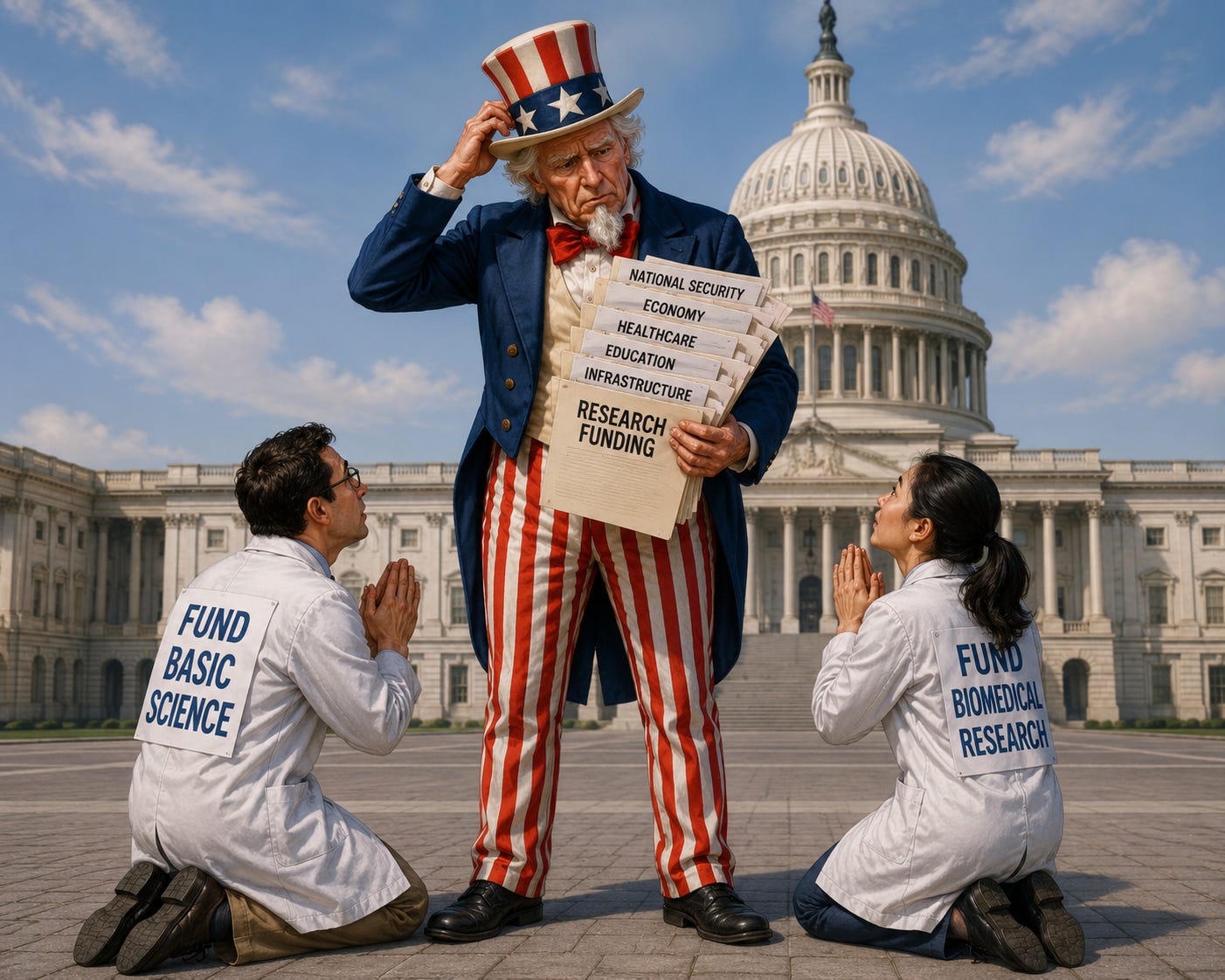
This proposed new standard appears in the Regulation for Federal Financial Assistance, which lists concerns of the OMB. Thankfully, our Uncle Sam has the good manners to ask us for our opinion on this proposal to change the Uniform Grants Criteria (UGR) standards. You and I have been asked to offer comments. So, let’s send those comments to Washington before July 13, 2026.
Subordinating Scientific Research to the President’s Policy Priorities
The proposed new regulations amount to book burning. Scientists will receive research funding from Uncle Sam based not on merit but on advancing the president’s policy priorities. Have we seen this before? Yes.
In the 1930s, the Deutsche Studentenschaft (German Student Union) ceremoniously burned books it deemed incompatible with the ideology of National Socialism. Initially, the works of Karl Marx were subjected to flames. Then the works of physicist Albert Einstein and numerous others who did not advance der Führer’s policy priorities. What were those policy priorities needing help from scientists? Eugenics. Rassenhygiene (racial hygiene). Gas chambers. Genocide.

Justification of genocide began with book burning. Might the proposed US regulatory changes resemble the book-burning of a century ago? Can we douse the fire before it becomes too hot?
To prevent unceremonious book-burning becoming the norm in the United States, perhaps the moment has arrived for those of us who treasure academic freedom and who foster scientific innovation to provide the comments requested.
Here is what you do. Go to Uncle Sam’s website and read the proposed list of changes to UGR. Because the document is long and tedious, get ready to sip your two-shot Caffè Mocha for sustenance.
Decide what you approve and don’t approve. Click on “Submit a Public Comment.” Then give Uncle Sam a piece of your mind.
Ted Peters’ Comments to Uncle Sam
Here is what I wrote to Uncle Sam, just in case you would like to know.
COMMENTS on Uniform Grants Regulation (UGR)
Some proposed changes in Uniform Grants Regulation should be applauded and celebrated. Others are dangerous to scientific advancement and to academic freedom. These provisions must be modified if not rejected.
Regarding proposed improvements in “transparency, accountability, and oversight,” my experience has been only positive. I served as Principal Investigator for a NIH grant (HG00487) in genomics and a second one with DOE in high level nuclear waste siting. I served one stint as a grant advisor for NIH. I can report that the contracted scientific peer reviewers in close collaboration with government agency administrators demonstrated admirable levels of competence, professionalism, and transparency. I do not see here a problem that needs fixing.
I applaud and celebrate reading in Section 200.219. “A recipient or subrecipient of Federal financial assistance must not discriminate on the basis of the viewpoint, content, or subject matter of speech—including on the basis of political, ideological, or religious affiliation or perspective—in providing services for events, meetings, or other expressive activities. This requirement would ensure that public entities do not improperly use control over facilities or services to disadvantage or suppress the speech of disfavored groups.” Such a provision protects academic freedom. Hooray!
I similarly applaud and celebrate Section 200.300. “OMB proposes to add a new paragraph (c) regarding non-discrimination against faith-based organizations. The proposed paragraph (c) provides that Federal agencies and pass-through entities may not discriminate against or in favor of an applicant on the basis of the organization’s religious character, affiliation, exercise, or lack thereof, nor on the basis of conduct that would not be considered ground to favor or disfavor a similarly situated secular organization.” This is warranted because religiously affiliated universities of different faith traditions are quite capable of contributing to advancing scientific knowledge that meets the highest standards. Their funding request should be measured and evaluated according to scientific standards comparable to applicants of secular institutions. Hooray!
Nevertheless, it makes me viscerally nervous to read Section 200.205. Federal grants should be “ensuring that discretionary awards advance the President’s policy priorities.” Why? Progressive scientific research programs can advance knowledge without regard to one or another presidential administration. Does this proposed provision subject research to a particular ideological stance or to the whim of a single individual in office only temporarily?
The danger rises further in Section 200.205 with this provision: “peer review remains advisory and does not replace agency discretion.” In effect this proposal gives ultimate power to political appointees. It diminishes the role of expert peer-reviewers to accept or reject federal grant proposals.
The UGR similarly imposes strict limitations and unnecessary bureaucracy on publications, publication costs (200.461), funds for conferences (200.232), as well as international collaborations. Studies that are considered “controversial” such as climate change, or do not align with White House priorities, will not get funding. Such proposed changes would be unacceptable to the research community. They would subordinate the creative pursuit of knowledge to supervision that could hide ideological agendas beneath bureaucratic restrictions.
In summary, this UGR proposal would send American science back to the Lysenko era of ideological repression during Soviet Leninism. Academic freedom and the very gold standard of science would be compromised.
SST Alliance: Science, Skepticism, and Theology
Let me mention that for some time now I have been cajoling my religious friends to make an alliance with scientists in lab coats and with skeptics who are critical of our post-truth culture. Scientists and skeptics could benefit from support coming from religious communities.
I try to justify what I dub the SST Alliance between Science, Skepticism, and Theology. For details, click on: “The SST Alliance: Public Theology, Scientific Reasoning, and Skeptical Inquiry in a Post-Truth Age,” just published in Kamasean: Jurnal Teologi Kristin.

Astronomer Grace Wolf-Chase and Michael Zimmerman
Grace Wolf-Chase, astronomer and Senior Scientist at the Planetary Science Institute, and Michael Zimmerman, editor of the Clergy Letter Project, are already engaged in public advocacy. Thanks, Grace and Michael.
Additional comments on the proposed changes
Let me share additional concerns raised by Grace Wolf-Chase. She is horrified at what is being proposed by OMB. Speaking for herself and not on behalf of the Planetary Science Institute, even though her colleagues at the Planetary Science Institute are also offering comments. Grace Wolf-Chase writes.
§200.205: “Gold Standard Science” is tied to Executive Order 14303. Giving political appointees ultimate authority to determine scientific merit undermines the expert peer review process. This is completely contrary to the flourishing of high-quality science, which can only be achieved when scientists are not compelled to align their research with any kind of political agenda. Many of history’s most important discoveries and scientific breakthroughs, from the discovery of penicillin to radioactivity, have occurred serendipitously. Curiosity-driven research and interactions across different scientific disciplines lie at the root of advancements in astrobiology and human space exploration. Imaging technology developed for the Hubble Space Telescope enabled medical advances in mammography and retinal imaging. These advances were not achieved by channeling research in a specific direction, but by the unencumbered exchange of ideas that enables science to flourish.
§200.206: Denial based on organizational “affiliations”: The preamble’s phrasing of what could disqualify grant recipients is so broad it could be used to disqualify researchers affiliated with, for e.g., grassroots interfaith organizations dedicated to environmental work that improves conditions in local communities, or organizations that lead science programs to benefit the poor around the world (e.g., equipping impoverished communities with telescopes).
§200.300: DEI and Gender Research: “Gender ideology”, defined as the theory that “denies the biological reality of sex or the sex binary” renders invisible (for example) individuals born with characteristics of both sexes or with chromosomal combinations other than XX and XY. Research into nonstandard sex chromosome combinations has provided foundational insights into autoimmune diseases, cancer immunology, and has advanced the field of endocrinology. “Biological reality” is not a mathematical axiom.
§200.340: Terminating grants at any time for any reason would be devastating for ongoing research projects, particularly research that funds the next generation of scientists. In addition to “encouraging” talented young scientists to leave the field or the U.S., this provision wastes resources and taxpayer money.
§200.421: Taxpayers deserve to know where their money is going. Restricting public science communication, whether to the public or to the press, runs counter to everything that might inspire talented young people to consider scientific careers. I have led public participation in science (citizen science) for many years. My current research was motivated by a discovery made by citizen scientists. Enabling public participation in science is a critical part of the “broader impacts” that advance public understanding of science.
§200.432: Pre-approval of conference attendance: It is typically impossible to identify field-specific conference locations at the time of a grant submission or award. This constraint would preclude many scientists from interacting and sharing their research at conferences.
§200.461: Publications Costs and Open Access: Researchers require grant funds to access and publish in peer-reviewed journals. This is how research gets critiqued and how scientists are made aware of developments in their fields. Federal funding for these costs is integral to successful projects.
Conclusion
Here is my admonition: for the sake of the common good, public policy should be based on evidence-based reasoning. An alliance between our scientists, skeptics, and theologians should provide a united front on behalf of evidence-based reasoning. This is almost like defending the truth against ideology, fake news, and power politics. Mmmmm? Maybe it actually is defending truth.
Substack PT 2021. Help rescue science from book burning! Comments on proposed federal funding regulations
Substack PT 2022. SST: Science, Skepticism, and Theology Alliance
Recommended Readings
Peters, Ted. 2019. “Allies in the Struggle Against the Post-Truth Swarm.” Theology and Science 17:4 427-430.
Peters, Ted. 2018. “The Power of Lies and the Lies of Power.” In Navigating Post-Truth Alternative Facts, ed. Jennifer Baldwin, 19-30. Lanham: Lexington.
Peters, Ted. 2026. “The SST Alliance: Public Theology, Scientific Reasoning, and Skeptical Inquiry in a Post-Truth Age.” Kamasean: Jurnal Teologi Kristin 7:1 87-102.
▓
Meet Ted Peters. For Substack, Ted Peters posts articles and notices in the field of Public Theology. He is a pastor in the Evangelical Lutheran Church in America and an emeritus professor at Pacific Lutheran Theological Seminary and the Graduate Theological Union. His single-volume systematic theology, God—The World’s Future, is now in its 3rd edition. He has also authored God as Trinity plus Sin: Radical Evil in Soul and Society, as well as Sin Boldly: Justifying Faith for Fragile and Broken Souls. In 2023, he published The Voice of Public Theology, with ATF Press. More recently, he has published an edited volume, Promise and Peril of AI and IA: New Technology Meets Religion, Theology, and Ethics (ATF 2025), and, along with Arvin Gouw, an edited collection, The CRISPR Revolution in Science, Religion, and Ethics (Bloomsbury 2025). Soon to be released is a volume of essays, A Handbook on Astrobiology, Astrotheology, and Astroanthropology, co-edited with Carolina Azucena Sanz de la Fuente and Arvin Gouw, with ATF.
See his website: TedsTimelyTake.com and Patheos blog site.
▓