


Substack PT 1025. Debating AI: Rebuttal to Ilia Delio by Michael E Zimmerman. Should we confer dignity on the superintelligent posthuman? Episode 5
Ilia Delio is constructing a wondrous and sublime worldview replete with a redemptive future that is cosmic in scope. She celebrates the dynamics of evolutionary advance and foresees how Artificial Intelligence will play a substantive role in the rise of expanded and deepened consciousness. Her inspiration is drawn from Teilhard de Chardin.
“Teilhard would have been at home with the new world of artificial intelligence because it continues to build the global brain into the future” (Delio, 2026, 360).
“The wise person of deep insight envisions the power of technology to knit humankind into one family, a cosmic body of unity” (Delio, 2026, 361).
In our Substack debate, Delio has taken the affirmative on our proposition.
Our global society should support the advancement of AI technology for enhancing humanity and even generating a posthuman species.
In “Substack PT 1024. Debating AI, Post-Humanity, and Ilia Delio. Should we confer dignity on the superintelligent posthuman? Episode 4,” I offered a pensive rebuttal. Now Michael E. Zimmerman, Emeritus Professor of Philosophy at Tulane University and the University of Colorado at Boulder, offers an additional rebuttal.
Actually, what we label a “rebuttal” is less a rebuttal and more an extension of an already fruitful discussion.
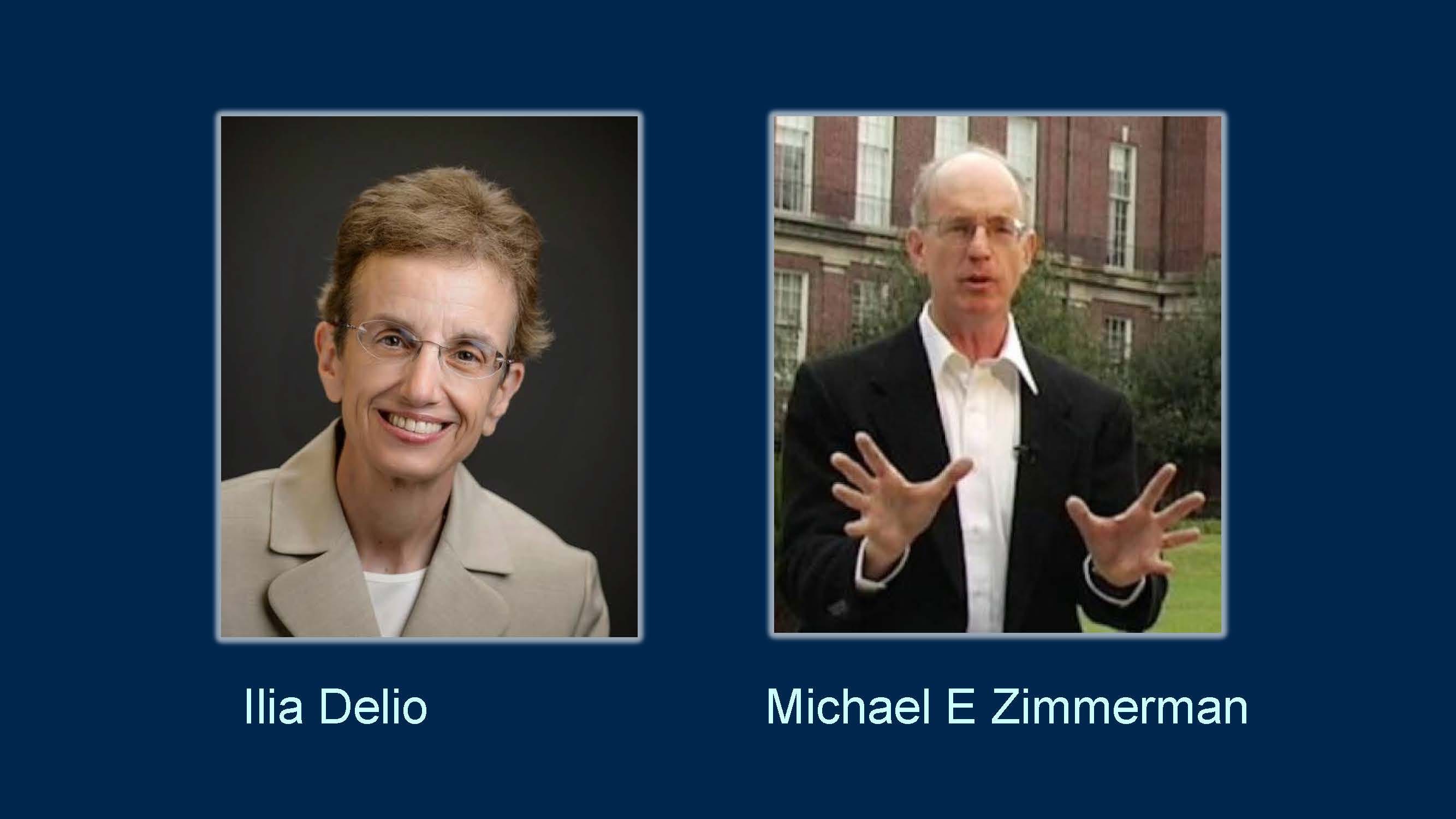
Michael E. Zimmerman’s Rebuttal to Ilia Delio
Michael E. Zimmerman writes. In what follows, I comment on Ted Peters’ thoughtful interchange with Ilia Delio, two accomplished theologians who are exploring the question of the possible “dignity” of super-intelligent posthumans. Drawing on the work of Jesuit priest Teilhard de Chardin, and echoing themes from Ray Kurzweil’s book, The Singularity is Near: When Humans Transcend Biology (2005), Delio asks whether superintelligent AGI will develop an interiority akin to that of people, thereby inviting or even requiring us to grant AGI the dignity that we accord to one another. I tend to agree with Ted’s concerns about granting personhood status to super-smart robots and lauding techno-posthumanism as an evolutionary advance that will transform the cosmos.
The issue of possible personhood/dignity for potential AGI has arisen because many key players in Silicon Valley seek not only wealth and fame, but above all an ersatz immortality, made possible (so they hope) by uploading into AGI a digital replica of their own brain/minds. They hope to “meld” with AGI, although no one really knows what this would involve. AGI’s silicon substrate is far more durable than humankind’s carbon-based substrate, which techno-posthumanists regard with disdain and even embarrassment. They anticipate the day when they can leave the “meat” behind and live forever in a digital realm, perhaps like an upgraded Holodeck (see Star Trek) in which one can design and realize one’s dreams, one after the next.
Even having uploaded one’s brain/mind into AGI, however, doesn’t guarantee eternal life. A good-sized meteor or a planet-sterilizing barrage of gamma rays from a nearby supernova or a massive volcanic eruption would likely destroy the conditions (such as electricity and the fuel needed to produce it) needed for AGI to function. AGI-enabled immortality amounts to a longer life span, perhaps even a much longer life span, for whomever it is that has uploaded into it. Currently, of course, such considerations are speculative. Will such “uploading” ever be possible, even if desirable?
Humans have always hoped for a long and healthier life, which modernity has made possible for billions of people. Curing disease, correcting genetic deformations, and otherwise enhancing human life are noble goals. Searching for the “fountain of youth” has never gone out of fashion. For thousands of years, religious traditions have promised that there is eternal life beyond the mortal one that involves so much suffering, including dying. People reporting near-death experiences (NDE) tell us that they discover first-hand that they are not limited by their bodies and that there is life after death. Similar reports come from people who ingest entheogens (psychedelic drugs), because the “trip” reveals that the constricted “self” to which we cling conceals the extraordinary expanse beyond.
Meantime, however, we remain mortal. How to come to grips with this? As Ernest Becker showed in his Pulitzer Prize-winning book, The Denial of Death, most of us seek distractions that keep our personal demise out of view. But what if we conceive of our mortality not as a problem to be ignored or as an obstacle to be overcome but rather as an essential aspect of human existence that we ought to cultivate? Mortality and our 2 awareness of it can grant meaning and urgency to our lives.
Within the finite horizon opened up by temporality (past, present, future), people and things can reveal themselves in various ways. If my horizon is constricted, for example, by fear or prejudice, or by the lust for power, a person from a group other than my own may show up as threatening or as unimportant or as useful only for enhancing my quest for ever greater power. If my horizon is more open, other people and things tend to show up rather differently. What shows up for many people today in the face of superintelligent AI is the prospect of having their careers taken by AI agents. This prospect is promoted by Silicon Valley executives who promise corporations that replacing people with computers will enhance their profits and growth. How such a dramatic change in employment will affect human dignity is one of many AGI-related topics addressed by Pope Leo XIV’s 2026 encyclical, Magnifica Humanitas.
Christianity promises eternal life after death, but here’s the thing: You still have to die. Even Jesus Christ died on the cross. People often conceive of life after death as the soul shedding its body and floating around in Heaven. Such a neo-Platonic view regards mortal flesh as inferior to higher, non-physical realms. A version of this view is shared by many in Silicon Valley who want to overcome their material existence.
From a Christian perspective, however, a negative evaluation of embodiment was contradicted by Christ’s decision to incarnate as a human being. According to Scripture, moreover, at the End Times our bodies will be resurrected, transformed, and recognizable, revealing aspects of the trials and suffering and attainments that individuals experienced as mortals.
Suffering is not merely negative, but also presents an opportunity for increased compassion, love, care, responsibility, and closeness to God, as Teilhard maintained in his semi-mystical later writings. In showing his crucifixion wounds to his astonished disciples, Christ acknowledged his own human suffering, while promising that suffering will be transfigured in the New Creation suffused with God’s love.
Christianity involves a hard teaching: That the Son of God willingly underwent the horrors of crucifixion to atone for our sins. The New Testament promises that Christ will return (at an unspecified time) to judge the living and the dead, while creating the world anew. The small time- and space-frames of the New Testament, however, cannot be easily squared with the enormous size and age of the universe.
How to make sense of the Christian promise of a New Creation in a universe with trillions of galaxies?[1] Teilhard’s book, The Phenomenon of Man (1955), takes on aspects of that question. Composed during the 1930s, the book was published posthumously because he knew it would be controversial in Catholic circles. The incarnation, that is, the moment when the Son of God as cosmic Logos became “flesh,” was a crucial moment in cosmic history, but how will the subsequent New Creation come about?
According to Teilhard, Creation is an evolving process, as in the formation of the noosphere, a complex membrane of information technology that envelops the globe. Some claim that Teilhard (like Arthur C. Clarke later on) was anticipating the World Wide Web, a nerve-like constellation of point-to-point wired or wireless connections. Eventually, if this connectivity continues to expand, humankind and the planet Earth will attain the Omega Point when everything becomes integrated and unified as the cosmic Christ.
Such notions, regarded in mid-century as theologically suspect, now receive a more appreciative attitude by theologians grappling with the implications of technological change.[2]
In The Singularity Is Near (2005), noted inventor and futurist Ray Kurzweil offers his own updated evolutionary view: AGI will eventually transform not only the posthuman future, but the entire cosmos itself. Engaging in explicit God-talk, he envisions the astonishing prospect of complex intelligence spreading throughout the universe, awakening and thus transforming all hitherto “dumb” matter. This development, he opines, would be as close to God as we can get. (Zimmerman 2008).
In view of human fallenness (in secular terms: the frequently hubristic failures to anticipate the dark fruits of our actions), why ought we to hold an optimistic view about the outcome of the oncoming, largely unregulated release of AI? Will not AI soon be able to redesign/reprogram itself in ways that optimize its powers and thus become AGI—and quickly realize that the very existence of (most) humans impedes its own drive toward ever greater power? In If Anyone Builds It, Everyone Dies, Eliezer Yudkowsky and Nate Soares describe the multiple existential threats that AGI poses for humankind. The same AGI that could spread intelligence throughout the universe could also be used for autonomous military systems with access to nuclear weapons.
Self-destruction via atomic weapons may be one of the “filters” that prevent other stellar civilizations (should there happen to be any) from moving to a higher stage of technology and culture. Science fiction offers us the example of “Skynet,” the computer-controlled, satellite-based missile defense system depicted in The Terminator. Skynet becomes self-conscious, leading the Defense Department to try to destroy it, but Skynet defends itself by attempting to exterminate humankind.
In 1968, a few years after the English translation of Teilhard’s book appeared, Stanley Kubrick’s groundbreaking film 2001: A Space Odyssey explores another computer that attempts to kill those it is designed to help. (Arthur C. Clarke co-authored the book that Kubrick turned into a film.) Some years before the year 2001, while on a mission to the Moon, astronauts discover a monolith (shaped like a cinema screen on end) long buried beneath the lunar surface. When someone touches it, the monolith sends a massive signal to Jupiter. Years later, Americans build a giant spaceship to explore what’s up with Jupiter. During the voyage, HAL, the nickname for the supercomputer that runs the spaceship, begins killing the crew because HAL does not trust them to complete the mission. After killing Hal, by deleting its memory, the surviving astronaut Dave eventually undergoes a terrifying, traumatic, yet transformative process directed by the intelligence that has abducted him. This intelligence seemingly harnesses cosmic energy generated by the aligned solar planets. After the old, dying Dave touches the monolith now hovering before him, we are shown the Star Child, the transformed human being first gazing upon planet Earth, then turning its eyes to meet the gaze of the film’s audience as the film ends.
Notably, this ostensible next stage of human evolution is not a metallic, robotic, post-human AGI, but rather an organism with large eyes, penetrating intelligence, floating in silence, beautiful, but uncanny, unsettling, reminiscent in some ways of the alien-human hybrids that we have heard about. The enigmatic Star Child is open to 4 multiple interpretations. Given that God works in mysterious ways, why not explore the possibility that the Star Child represents the transformed humanity promised in the New Testament?
The film’s musical coda, from Richard Strauss’s “Also Sprach Zarathustra,” offers a clue to another interpretation. Nietzsche had no interest in having humankind evolve into superintelligent, virtually immortal computers, but rather in attaining the pinnacle of human existence—a pinnacle so extraordinary that it would inspire the rest of us.
Nietzsche’s Overman affirms mortal existence to such an extent that he resents nothing of what has happened in his life. Indeed, he is willing to live it over and over again, just as it has been, for all eternity. The Overman’s extraordinary active stance to life has led some to suggest that the Overman is the Buddha.
Consider now the life of Christ. Did he spurn the crucifixion, or did he embrace this gruesome death as his destiny? What example did he set? His own answer: Take up your cross and follow me? What is my cross? The suffering involved in being human, including the sins I commit that can harm others more than disease or accident. Where will carrying my cross lead me? To a transfigured life here and now. Instead of pining away for the afterlife and scorning the present life, Jesus suggested something different.
Live your life in a way that is fearless, generous, affirmative, active, forgiving, forbearing, and devoted to God and community. Encourage others to do the same. Help create the Kingdom of God within you and others in the here and now. Leave it to God to welcome you into the Kingdom to come. There is no denying that leading such a life is far from easy in view of our sinful inclinations.
I have no crystal ball about where evolution—natural or artificially-generated—is taking us. For all I know, a technologically inspired vision of a posthuman future may both occur and somehow be a boon in many senses—at least for a time. Perhaps the New Creation promised by Christ will somehow be facilitated by such developments.
In the meantime, I celebrate having been born a mortal on this extraordinary planet in a cosmos created by a God who sent his son to live among us. 1 When the sheer number of galaxies is trotted out to claim that life must be abundant in the cosmos, or even in the Milky Way galaxy, far greater numbers are involved in the odds against DNA having “accidentally” arisen. Likewise for odds against the existence of other planets with intelligent life, as proponents of the “rare Earth” hypothesis maintain. There are good reasons to posit an Intelligence that created the universe.
Notes
[1] When the sheer number of galaxies is trotted out to claim that life must be abundant in the cosmos, or even in the Milky Way galaxy, far greater numbers are involved in the odds against DNA having “accidentally” arisen. Likewise for odds against the existence of other planets with intelligent life, as proponents of the “rare Earth” hypothesis maintain. There are good reasons to posit an Intelligence that created the universe.
[2] I decided to read on my own The Phenomenon of Man in 1965 as a college freshman. Admittedly, a lot of it was over my head, but I grokked its idea of an evolutionary advance involving ever greater complexity enabled by human global communication. How this squared with Christian theology, insofar as I understood it as a young Catholic, was not clear.
Ted Peters’ Response
As mentioned above, what we call a “rebuttal” may function much more as an extension of the discussion. Thanks to Professor Zimmerman for extending the discussion of our evolutionary future.
Substack PT 1025. Debating AI: Rebuttal to Ilia Delio by Michael E Zimmerman. Should we confer dignity on the superintelligent posthuman? Episode 5
AI and FAITH. “Magnifica Humanitas: AI and Faith at the Vatican”
VIDEO. “How then shall we live? Meaning in the Age of AI” St. Gregory Nyssa Epis SF, June 7, 2026
Substack PT 1022. Debating AI, Post-Humanity, and Arvin Gouw. Should we confer dignity on the superintelligent posthuman? Episode 2
Substack PT 1023. Debating AI, Post-Humanity, and Augustine Pamplany. Should we confer dignity on the superintelligent posthuman? Episode 3
Substack PT 1024. Debating AI, Post-Humanity, and Ilia Delio. Should we confer dignity on the superintelligent posthuman? Episode 4
Substack PT 1025. Debating AI: Rebuttal to Ilia Delio by Michael E Zimmerman. Should we confer dignity on the superintelligent posthuman? Episode 5
Substack PT 1026. Debating AI. Noreen Herzfeld asks: Is Claude Conscious? Should we confer dignity on the superintelligent posthuman? Episode 6
Substack PT 1027. Debating AI, Post-Humanity, and Ahmed Khater. Should we confer dignity on the superintelligent posthuman? Episode 7
Substack PT 1028. Debating AI, Post-Humanity, and Hava Tirosch-Samuelson. Should we confer dignity on the superintelligent posthuman? Episode 8
Substack H+ 2029. Epstein, Pope Leo XIV, and Christian Transhumanism. Michael West and Micah Redding on Technological Salvation. Part 8.
Substack PT 1029. Debating AI, Post-Humanity, and Carolina Sanz de la Fuente. Should we confer dignity on the superintelligent posthuman? Episode 9
Substack PT 1030. Debating AI, Post-Humanity, and Calvin Mercer. Should we confer dignity on the superintelligent posthuman? Episode 10
Substack PT 1031. Debating AI, Post-Humanity, and Levi Mahroni Checketts. Should we confer dignity on the superintelligent posthuman? Episode 11
Substack PT 1032. Debating AI: Techlash Against Frankenstein? Should we confer dignity on the superintelligent posthuman? Episode 12
Substack PT 1033. Debating AI and the Ban Artificial Superintelligence Act. Should we confer dignity on the superintelligent posthuman? Episode 13
Substack PT 1034. Debating AI, Post-Humanity, and Braden Molhoek. Should we confer dignity on the superintelligent posthuman? Episode 14
Substack PT 1035. Debating AI’s Fall into Sin. Should we confer dignity on the superintelligent posthuman? Episode 15
Substack PT 1036. Debating AI’s Future With or Without Us. Should we abort our posthuman children before they are born? Episode 16

▓
Meet Ted Peters. For Substack, Ted Peters posts articles and notices in the field of Public Theology. He is a pastor in the Evangelical Lutheran Church in America and an emeritus professor at Pacific Lutheran Theological Seminary and the Graduate Theological Union. His single-volume systematic theology, God—The World’s Future, is now in its 3rd edition. He has also authored God as Trinity plus Sin: Radical Evil in Soul and Society as well as Sin Boldly: Justifying Faith for Fragile and Broken Souls. Peters edited The Promise and Peril of AI and IA: New Technology Meets Religion, Theology, and Ethics (ATF 2024), and he recently published The Voice of Public Theology, with ATF Press.
See his website: TedsTimelyTake.com and Patheos blog site.
▓
References
Checketts, Levi. 2022. “Homo Gubernator as a Teilhardian-Catholic Response to Transhumanism.” Religious Transhumanism and Its Critics, eds., Arvin M. Gouw, Brian Patrick Green, and Ted Peters, 341-354. Lanham, MD: Lexington.
Checketts, Levi. 2024. Poor Technology: Artificial Intelligence and the Experience of Poverty. Minneapolis, MN: Fortress.
Delio, Ilia. 2026. “Teilhard de Chardin on Technology and Human Evolution.” Eds., Georg Thiener and Alcibiades Maplapi-Nelson, Technologies of the Future Self: An Ethics for Transhuman Flourishing. New York: Palgrave, 335-362.
Herzfeld, Noreen. 2024. “The Eschatological Future of Artificial Intelligence: Savior or Apocalypse?” Eds., Beth Singler and Fraser Watts. Cambridge Companion to Religion and Artificial Intelligence. Cambridge, UK: Cambridge University Press, 148-164.
Zimmerman, Michael E. 2008. “The Singularity: A Crucial Phase in Divine Self-Actualization.” Cosmos and History.