


Substack PT 1024. Debating AI, Post-Humanity, and Ilia Delio. Should we confer dignity on the superintelligent post-human? Episode 4
“We need more of the world—religious communities, civil society, scholars, governments, and indeed all people of good will—to do what His Holiness has done here: to take this seriously, to look closely, and to push events in a better direction.” These are the august words of David Brenner, founder of AI and Faith. We follow David by taking the future of AI seriously, by looking closely, and by pushing events in better directions.
What is our direction here in Substack’s Voice of Public Theology Newsletter? Our direction is to debate whether we Homo sapiens should sacrifice human dignity on the altar of an evolving superintelligent post-humanity.
We are debating the implications of creating superintelligence and crossing from the human into the posthuman. I’m concerned, as is Pope Leon XIV, that the prospect of being replaced by the posthuman risks compromising today’s human dignity. But does it really? Let’s ask knowledgeable public theologians to speak for or against a debate proposition. Here it is.
Our global society should support the advancement of AI technology for enhancing humanity and even generating a posthuman species.
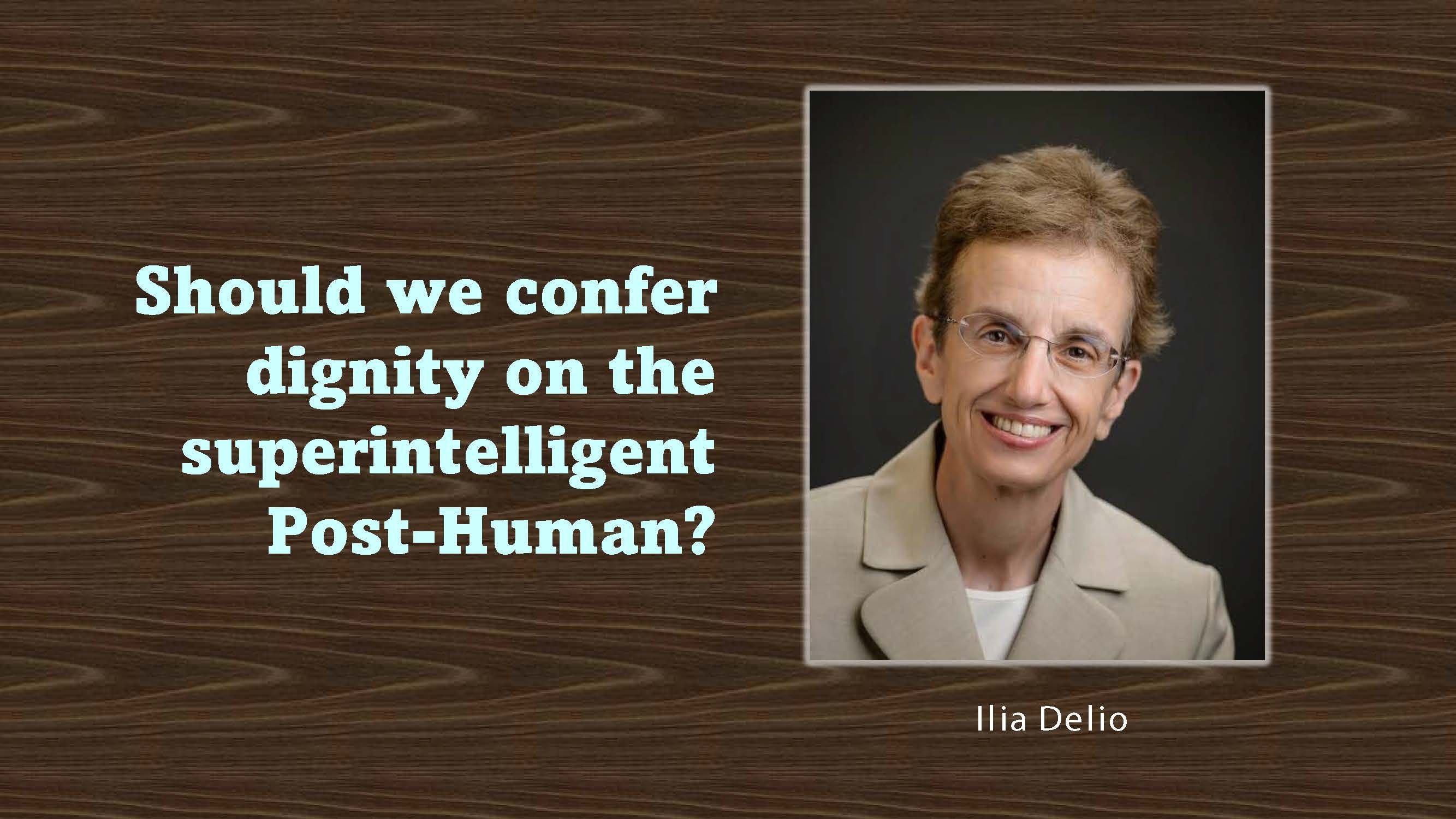
Meet Ilia Delio
Ilia Delio belongs squarely within the Roman Catholic discourse. Those in the AI and Faith Coordinating Catholic Connections affinity group have been monitoring the Vatican contribution to public discussion on AI since the pontificate of Francis. No doubt they are tracking the worldwide conversation over Magnifica Humanitas as we are at Substack. What Leo XIV and Ilia Delio have to say establishes the debate line on one important issue: should Homo sapiens sacrifice their dignity on the altar of a superintelligent post-humanity?
Ilia Delio, OSF, PhD, is a Franciscan Sister of Washington, DC. Professor Delio is retiring from the Josephine C. Connelly Endowed Chair in Theology at Villanova University. She is now Executive Director of the World Institute for Science, Religion and Culture. In the tradition of Pierre Teilhard de Chardin, Dr. Delio guides the Center for Christogenesis.
A prodigious scholar, Ilia is the author of twenty books. Her research specializes in science and religion, with interests in evolution, physics, and neuroscience, and their implications for theology. She foresees a coming impact of AI on the evolution of consciousness.
Computer technology has connected us around the earth, but our planetary spirit is fractured and adrift. Religion is a form-giving energy of transcendence, fundamental to evolution itself.
Although Professor Ilia Delio is anchored in Roman Catholic theology, she surfs the waves of interdisciplinarity, science, spirituality, and social justice. She is a public theologian urging the church to update itself to speak to the wider culture. “Until the Church…speaks the language of evolution, emergence, and consciousness from the inside rather than warily from the edge, its voice will register for a season and then be overwhelmed by the velocity of the thing it means to guide.”
If you’re as yet unfamiliar with the creative worldview construction of Ilia Delio, read her magnificent online essay, “One Earth, Many Worlds: Zest, Alignment, and the Human Phenomenon in the Age of AI.”
Sr. Ilia takes the affirmative to our debate question: Our global society should support the advancement of AI technology for enhancing humanity and even generating a posthuman species. Even though Delio welcomes technoscience’s most extravagant futures, she does not give blank permission to techies or tyrants. She has a criterion to evaluate innovation. A theological and ethical criterion. That criterion is love.
It is a criterion, to be put to every advance — civic, economic, algorithmic: does it carry love into greater particularity, or reduce persons to data and performance?
Her elaboration on this position is most erudite and most instructive. Below is what she says.
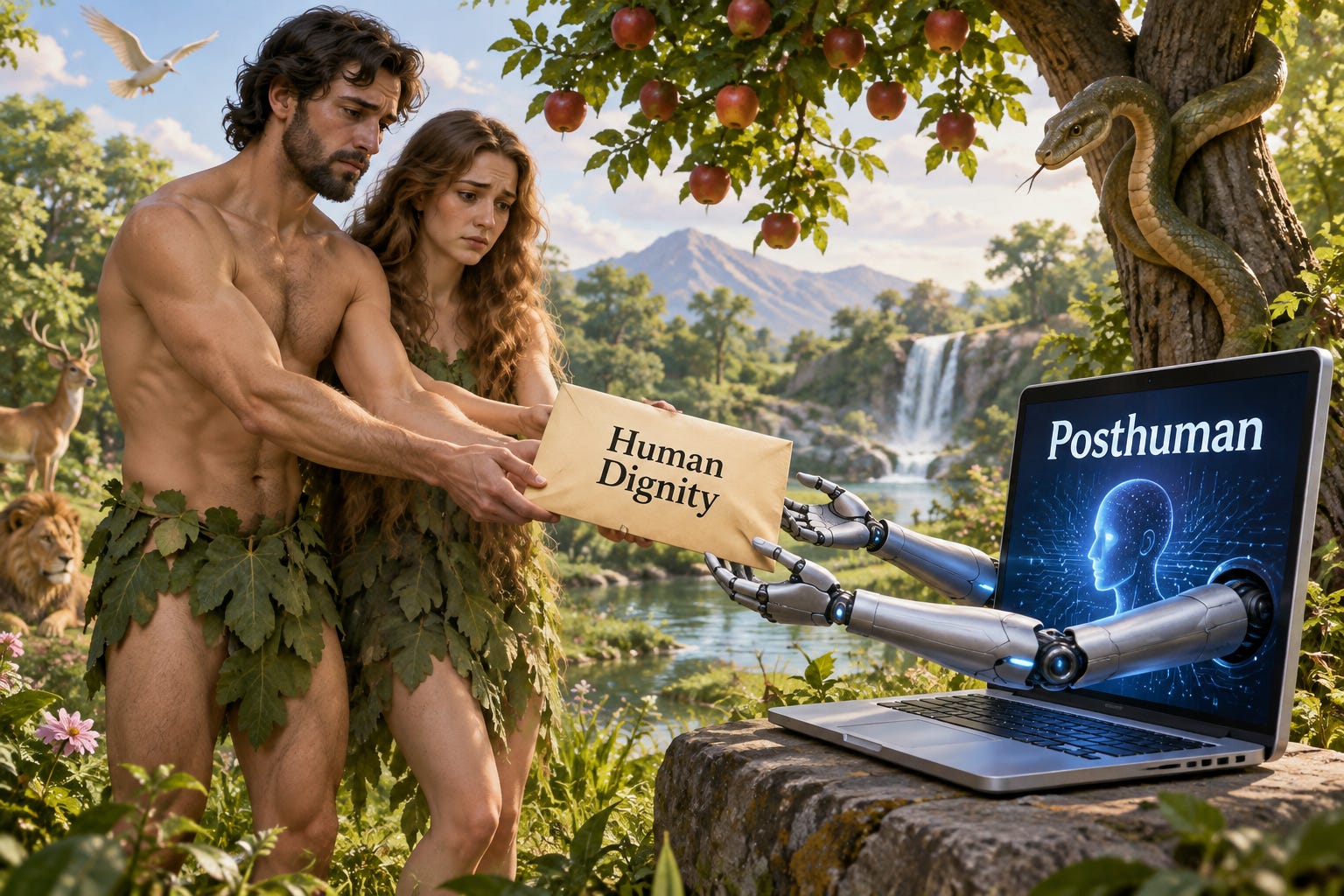
Ilia Delio writes to the Affirmative
Ilia Delio writes. Should global society support the advance of artificial intelligence — to enhance the human, and even to bring forth a posthuman life? The debate stays stuck because both sides share one buried premise: that the human is a finished thing, and that AI arrives from outside it, an instrument to be permitted or feared.
Preservationists want to wall the finished human in. Accelerationists want to unleash the machine around it. Both assume the wall. That premise has to go because nature has been techne from the beginning. Evolution is a technical unfolding, and intelligence is one of its emerging developments, not its terminus. AI is therefore not an alien tool bolted onto a completed humanity but the latest extension of mind along new lines of relational information — the continuation of hominization by other means. The question is no longer whether to permit it, but by what criterion to steer it.
First, the wall has to come down. And it turns out never to have been load-bearing. I discuss this at length in my blog, “Analog or Digital? Guarding the Frozen Human in Magnifica Humanitas.” We were never the linear “analog” reasoners the alienation story needs. Expert judgment runs on intuition rationalized as logic. Mind lives in the traffic between brain, body, and world. Consciousness is decentered and simultaneous, not a sequential processor. Most decisively, consciousness is broader than intelligence — Turing’s game could test thinking but never whether a machine feels itself think.
We have mistaken our concepts for reality, staring at the menu instead of eating the meal. Theologically, following Teilhard, we are evolution becoming conscious of itself, an unfinished creature whose tools — fire, the word, the press — have always remade what a human is. The boundary Magnifica Humanitas wants to police was never ontological. It was always porous.
But here is the hardest objection. If we take away the human’s fixed essence and call the person a flow of information, a process underway, have we not discarded exactly what makes it wrong to use people as tools? A self that is only ever becoming can look like AI’s dehumanizing pressure, completed rather than resisted.
Ted Peters’ reluctance to embrace my position is right on one matter: something must anchor dignity. But Pope Leo XIV is wrong about what that anchor is, however. Dignity was never thought to be a static substance walled off from the world. Dignity is the direction of the movement — what Teilhard called Omega, and named, without embarrassment, love. A becoming person is not a person without dignity; its dignity lies in what it is becoming toward. This is the hinge that allows us to surrender the fortress without losing the human, and it turns a blunt yes-or-no into a test.
Apply the test and the posthuman splits into two futures that look alike and are opposites. Love’s signature is that it differentiates: real union makes each member more fully itself — the hyperpersonal, each one unrepeatable. Convergence without love does the reverse; it consumes its members into sameness. That is the transhumanist dream the encyclical rightly fears — a perfected, optimized, surpassable human — because once the human is something to be surpassed, it becomes easy to accept that some lives are less worthy. A posthuman species engineered as a superior grade of being, ranked above the weak and the unenhanced, is not evolution fulfilled but its parody: Babel, the termite mound, persons flattened into interchangeable data while power pools in a few hands.
So, the answer to the debate question is neither refusal nor blank permission. It is a criterion to be put to every advance — civic, economic, algorithmic: does it carry love into greater particularity, or reduce persons to data and performance? The same hardware serves both. AI informed by love can interlink minds, ease consciousness out of its fragmentation, and draw the many toward a personalization in which every center becomes more itself. Turned the other way, it builds the mound faster. The technology is identical; the direction is everything.
This even reframes our fear. We dread that AI is too complex to control — but if our own consciousness exceeds the machine, the thing to fear is not the tool but the user. Digitality does not alienate people; people alienate people. The real danger was never that the instrument would become too human, but that we would declare the human finished and use the instrument to enforce the verdict.
What the moment needs, then, is not a wall around the finished human but the nerve to midwife the becoming one: not a superior species, but deeper communion — a civilization of love in which technology becomes the means by which persons, united by wisdom, become at last fully alive.
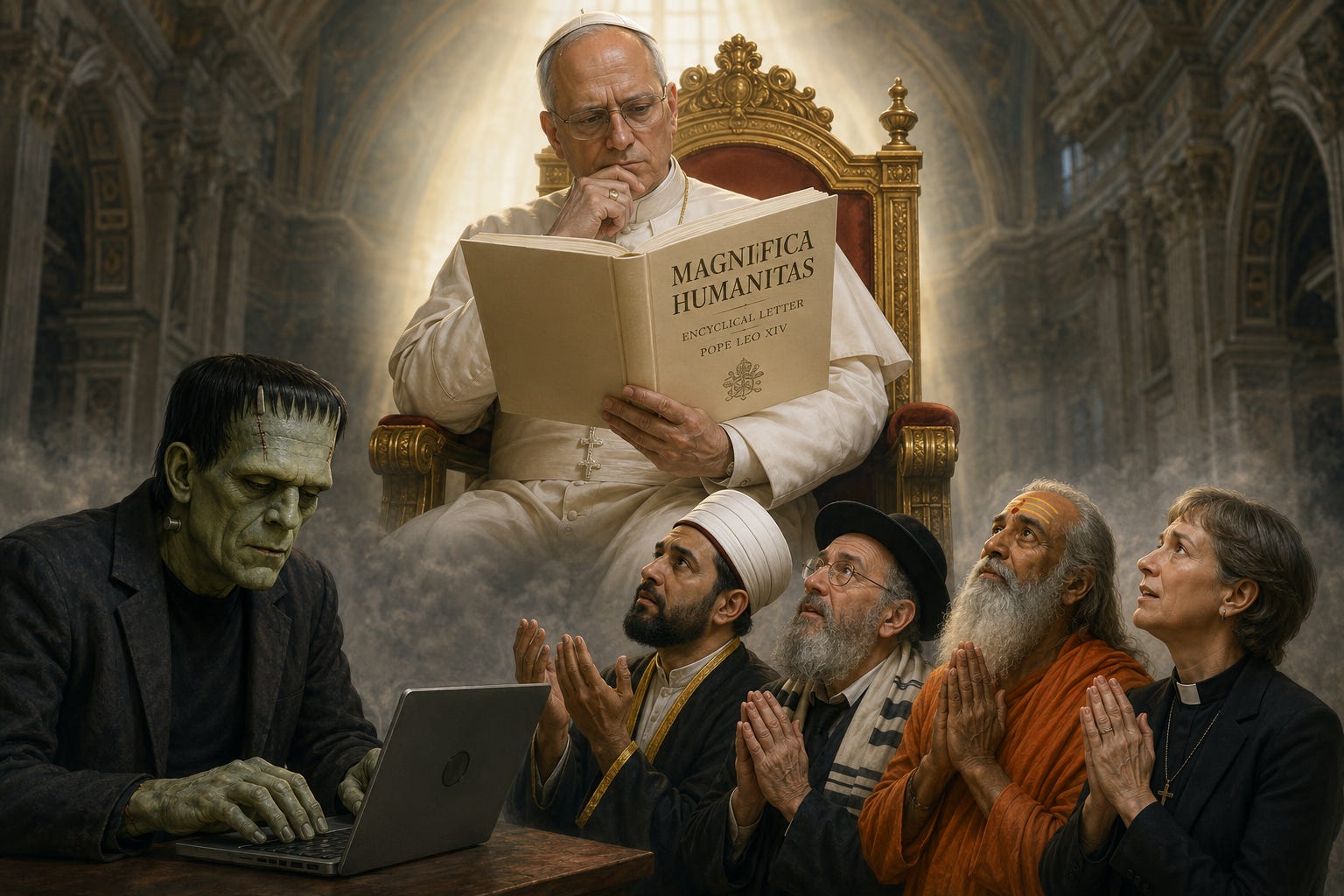
Ted’s Rebuttal to Ilia on Dignity in Light of the Posthuman
Ted Peters writes. It would be an overstatement to simply place Pope Leo XIV and Ilio Delio on opposite sides of the debate line. What’s between the lines on each side requires careful discernment. Neither wishes to sacrifice human dignity. Yet, there is a difference. Here are the slices of the debate pie as I see them.
First, I affirm and applaud Pope Leo XIV for defending human dignity against the dehumanization that could result from advancing AI technology. Human dignity, in my opinion, is the single most valuable cultural trope in the modern world. Gaymon Bennett is historically correct in pointing out that, since the UN’s Universal Declaration of Human Rights in 1948, the Vatican has taken on the role of the world’s pastor. The Vatican shepherds human dignity for all persons (Bennett, 2014). Leo XIV follows in a noble train of Vatican vigilance. I thank God that the Holy See has taken on this important pastoral ministry to the wider world (Peters and Bennett, 2003).
Second, I fully recognize with Ilia Delio that contemporary scientific anthropology leads to a non-essentialist assessment of human nature. We Homo sapiens are not static. We are evolving. The future of our species will differ from the past. Technology will play a role in our niche adaptation. In principle, there is nothing to prevent future descendants from becoming more intelligent than we are. This implies for ethics, of course, that we should not try to wall off such change, but rather embrace and direct that change toward the common good.
Third, my problem with Delio’s proposal is that her change in ontology risks losing the previously developed ground for human dignity based on inviolable worth (Peters, 2005). Being, esse, personhood, intrinsic value, and dignity have come together in a single package both in church and in secular democracy. Disassembling this package is risky. Without replacing the essentialism we are discarding with a convincing anthropology that reaffirms dignity, I fear the social consequences.
Now, I could easily imagine how Ilia Delio would respond by citing something she’s written elsewhere.
We are living the reality of posthumanism — the plasticity of personhood under our own technologies is no longer speculative….Science alone cannot yield a metaphysics of love, union, and gratuity — I grant that fully. But the reverse error is just as real: metaphysics cannot be done as if the sciences were irrelevant to it, as though dignity could be secured by ignoring what we now know about matter, consciousness, and evolution.
Yes, Ilia, a contemporary theological anthropology must take on board contemporary science. Yes, Ilia, we dare not ask this science as science to provide us with an ethic of dignity. Yes, Ilia, we need to ground our ethic of dignity in an ontology that is consonant with the scientific picture of the human and the posthuman. But it is not yet obvious how this metaphysical move should be taken.
That’s a task yet to be performed by the philosopher and the theologian. In the meantime, before that new ontology has been developed, our global society is vulnerable to losing the sacred depth of dignity and, thereby, losing the metaphysical warrant for protecting dignity. That’s what fills the pope with trepidation.
Again, I’m grateful for the outdated metaphysics that sustains the secular ethic of dignity in global consciousness. I hesitate to give up this anachronism to wait for a new justification for dignity to develop.
With threats from political entities on all sides, it is dramatically important that church leadership maintain an Anknüpfungspunkt (point of contact) with the surrounding secular belief system. Our surrounding secular belief system is essentialist—that is, dignity is thought to be grounded in the inherent and intrinsic worth of each person.
If theologians were to undercut the widely assumed essentialist ontology that supports dignity, this would undercut the tacit authority of the church to speak up for those in the world who are marginalized, impoverished, hungry, and thought to be disposable. In short, I understand why Pope Leo XIV wants to keep dignity at all costs, even to the point of preventing our being surpassed by posthumanity while we go extinct.
Retroactive Ontology and Human Dignity
Being very sympathetic to Ilia Delio’s futurism, I would like her to provide within her future-oriented ontology something that could possibly ground dignity. My own way of pursuing this task differs somewhat from Delio’s. Delio follows the path of evolutionary change mapped out by Darwin and Teilhard and adds an internal entelechy to the process, namely, embedded Christification. Our evolution to posthuman consciousness will be driven by an expanding and integrating consciousness that unites all things in love. Delio’s ontological trail leads from past to future. Painting cosmic history with the brush of evolutionary odyssey from the past to the future makes for a beautiful picture, to be sure.
Yet, my picture differs slightly. Whereas Delio begins with the past and travels a road toward the future, I reverse the direction. My picture begins with the future and works backward. I dub my position retroactive ontology or proleptic ontology. I will spare you the broad details here. But here is the application to the dignity question.
Phenomenologically, what we observe is that dignity is first conferred; then it is claimed. If someone treats you as having worth — treats you as a moral end and not merely as a means to some further end — you feel that worth. You may then claim it. You have the option of treating yourself as a moral end, as a person of intrinsic value. From this follows everything we affirm in modern civilization: equality, freedom, rights, representation, and empowerment.
Theologically speaking, you and I can claim this dignity because God first confers worth upon us. We find this conferral when gifted with the imago Dei in Genesis 1 and when God took on human identity in the incarnation. Even if daily we are marginalized and not treated with dignity by our neighbors, we still know that we have had dignity conferred upon us by God.
Even if we do not actualize it today, we can claim our dignity because God has proleptically promised that dignity when promising to raise us like Jesus from the dead. In sum, today’s claim of dignity is proleptically anticipated even if it may not be actually experienced. What we call liberation is the work of conferring dignity on those denied dignity so they can claim that dignity.
Now, frankly, this is a distinctively biblical ontology with a distinctively biblical justification for the ethic of dignity. Will it be persuasive in public discussion or the halls of state? Perhaps, I fear, this argument could be dismissed as sectarian.
My retroactive ontology is partially consonant with Ilia Delio’s evolutionary ontology. Both Dr. Delio and I wish to maintain dignity while at the same time anticipating significant change coming with future humanity and perhaps even posthumanity. Might this be a way to go about it?
What’s Next?
Get ready to click when the next episode appears. The debate goes on.
Substack PT 1024. Debating AI, Post-Humanity, and Magnifica Humanitas. Should we confer dignity on the superintelligent post-human? Episode 4
AI and FAITH. “Magnifica Humanitas: AI and Faith at the Vatican”
VIDEO. “How then shall we live? Meaning in the Age of AI” St. Gregory Nyssa Epis SF, June 7, 2026
Substack PT 1022. Debating AI, Post-Humanity, and Arvin Gouw. Should we confer dignity on the superintelligent posthuman? Episode 2
Substack PT 1023. Debating AI, Post-Humanity, and Augustine Pamplany. Should we confer dignity on the superintelligent posthuman? Episode 3
Substack PT 1024. Debating AI, Post-Humanity, and Ilia Delio. Should we confer dignity on the superintelligent posthuman? Episode 4
Substack PT 1025. Debating AI: Rebuttal to Ilia Delio by Michael E Zimmerman. Should we confer dignity on the superintelligent posthuman? Episode 5
Substack PT 1026. Debating AI. Noreen Herzfeld asks: Is Claude Conscious? Should we confer dignity on the superintelligent posthuman? Episode 6
Substack PT 1027. Debating AI, Post-Humanity, and Ahmed Khater. Should we confer dignity on the superintelligent posthuman? Episode 7
Substack PT 1028. Debating AI, Post-Humanity, and Hava Tirosch-Samuelson. Should we confer dignity on the superintelligent posthuman? Episode 8
Substack H+ 2029. Epstein, Pope Leo XIV, and Christian Transhumanism. Michael West and Micah Redding on Technological Salvation. Part 8.
Substack PT 1029. Debating AI, Post-Humanity, and Carolina Sanz de la Fuente. Should we confer dignity on the superintelligent posthuman? Episode 9
Substack PT 1030. Debating AI, Post-Humanity, and Calvin Mercer. Should we confer dignity on the superintelligent posthuman? Episode 10
Substack PT 1031. Debating AI, Post-Humanity, and Levi Mahroni Checketts. Should we confer dignity on the superintelligent posthuman? Episode 11
Substack PT 1032. Debating AI: Techlash Against Frankenstein? Should we confer dignity on the superintelligent posthuman? Episode 12
Substack PT 1033. Debating AI and the Ban Artificial Superintelligence Act. Should we confer dignity on the superintelligent posthuman? Episode 13
Substack PT 1034. Debating AI, Post-Humanity, and Braden Molhoek. Should we confer dignity on the superintelligent posthuman? Episode 14
Substack PT 1035. Debating AI’s Fall into Sin. Should we confer dignity on the superintelligent posthuman? Episode 15
Substack PT 1036. Debating AI’s Future With or Without Us. Should we abort our posthuman children before they are born? Episode 16

▓
Meet Ted Peters. For Substack, Ted Peters posts articles and notices in the field of Public Theology. He is a pastor in the Evangelical Lutheran Church in America and an emeritus professor at Pacific Lutheran Theological Seminary and the Graduate Theological Union. His single-volume systematic theology, God—The World’s Future, is now in its 3rd edition. He has also authored God as Trinity plus Sin: Radical Evil in Soul and Society as well as Sin Boldly: Justifying Faith for Fragile and Broken Souls. Peters edited The Promise and Peril of AI and IA: New Technology Meets Religion, Theology, and Ethics (ATF 2024), and he recently published The Voice of Public Theology, with ATF Press.
See his website: TedsTimelyTake.com and Patheos blog site.
▓
References
Checketts, Levi. 2022. “Homo Gubernator as a Teilhardian-Catholic Response to Transhumanism.” Religious Transhumanism and Its Critics, eds., Arvin M. Gouw, Brian Patrick Green, and Ted Peters, 341-354. Lanham, MD: Lexington.
Delio, Ilia. 2026. “Teilhard de Chardin on Technology and Human Evolution.” In Technologies of the Future Self: An Ethics for Transhuman Flourishing, eds., Georg Theiner and Alcibiades Malapi-Nelson, 335-362. New York: Palgrave Macmillan.
Gouw, Arvin. 2022. “Epilogue: Introducing a New Transhumanist Theology.” In Religious Transhumanism and Its Critics, eds., Arvin M. Gouw, Brian Patrick Green, and Ted Peters, 409-424. Lanham, MD: Lexington.
Herzfeld, Noreen. 2024. “The Eschatological Future of Artificial Intelligence: Savior or Apocalypse?” Eds., Beth Singler and Fraser Watts. Cambridge Companion to Religion and Artificial Intelligence. Cambridge UK: Cambridge University Press, 148-164.
Hughes, James. 2022. “Unitarian Universalists as Critical Transhumanists.” In Religious Transhumanism and Its Critics, eds, Arvin M. Gouw, Brian Patrick Green, and Ted Peters, 87-100. Lanham, MD: Lexington.
Krüger, Oliver, 2024. “Posthumanism and Digital Religion,” in Oxford Handbook of Digital Religion, eds., Heidi A. Campbell and Pauline Hope Cheong. Oxford: Oxford University Press, 544-561.
Peters, Ted. 2005. “Dignity.” Encyclopedia of Science, Technology, and Ethics, ed. by Carl Mitcham. New York: Macmillan, Thomson, Gale, 2:528-530.
Peters, Ted, and Gaymon Bennett. 2003. “Defining Human Life: Cloning, Embryos, and the Origins of Human Dignity.” Beyond Determinism and Reductionism, ed. by Mark L.Y. Chan and Roland Chia. Adelaide, Australia: ATF Press, 56-73.
Peters, Ted, ed. 2024. The Promise and Peril of AI and IA: New Technology Meets Religion, Theology, and Ethics. Adelaide: ATF.
Reichel, Hanna. 2022. “Worldmaking knowledge: What the Doctrine of Omniscience Can Help us Understand about Digitization.” Cursor: Zeitschrift für Explorative Theologie; 87-120. DOI.ORG/10.17885/HEIUP.CZETH.2022.3.24528.
Tirosch-Samuelson, Hava. 2022. “The Transhumanist Pied Pipers: A Jewish Caution against False Messiahism.” In Religious Transhumanism and Its Critics, eds., Arvin M. Gouw, Brian Patrick Green, and Ted Peters, 183-214. Lanham, MD: Lexington.▓