

Debating AI, Post-Humanity, and Carolina Sanz de la Fuente
Should we confer dignity on the superintelligent posthuman? Episode 9

Substack PT 1028. Debating AI, Post-Humanity, and Carolina Sanz de la Fuente. Should we confer dignity on the superintelligent posthuman? Episode 9
My son Paul, living in Florida, recently applied for a personalized license plate. He had just purchased a new Rivian, and my granddaughter, Madelaine, named the car “Toaster.”
Paul sought counsel from Claude. Because the actual Toaster name includes too many letters to fit on a Florida license plate, he asked Claude for abbreviated recommendations. Paul liked none of those Claude suggested. So, he asked Claude for an opinion on his own suggestion, “TOSTR.” Here is Claude’s answer.
“TOSTR” reads well — better than my earlier suggestions, honestly. It keeps the T-O-S-T-R skeleton of “toaster” in order, no letter swaps needed, and it’s phonetically close enough that most people will get it, especially with context (a Rivian with a toaster reference is already a fun mystery to solve).
From this interchange, Paul drew two conclusions. First, Claude is not as smart as his reputation would suggest. Second, Claude’s personality is quite courteous.
Is Claude developing a posthuman self with superintelligence? Not yet. Our AI techies have not yet birthed the Singularity or the global takeover by our posthuman children. Even so, it would behoove us to consider what the future might bring.
The Vatican Prophecy
The prospect of a future posthuman superintelligence worries both Pope Francis and Pope Leo XIV. Pope Francis admonishes us to keep machine intelligence aligned to human oversight.
“The commitment to ensuring that AI always supports and promotes the supreme value of the dignity of every human being and the fullness of the human vocation serves as a criterion of discernment for developers, owners, operators, and regulators of AI, as well as to its users. It remains valid for every application of the technology at every level of its use” (Francis 2025, §43).
We dare not risk surrendering our human dignity to a posthuman machine, Pope Leo XIV warns.
“In the era of artificial intelligence, when human dignity is threatened by new forms of dehumanization, ours is the pressing duty to remain profoundly human. We must lovingly safeguard the grandeur of humanity bestowed upon us and revealed in its fullness in Christ, the splendor of which no machine can ever replace” (Magnifica Humanitas, §15).
Over against the Vatican, our transhumanist friends enthusiastically greet the escape of the uncontrollable tiger from the AI zoo. With this in mind, we turn to Carolina Sanz de la Fuente and the task of public theology within the worldwide discussion. Specifically, should our inherited anthropocentrism, which justifies our doctrine of human dignity, be sacrificed on the altar of a post-anthropocentrism or post-humanism that is more ecologically holistic?
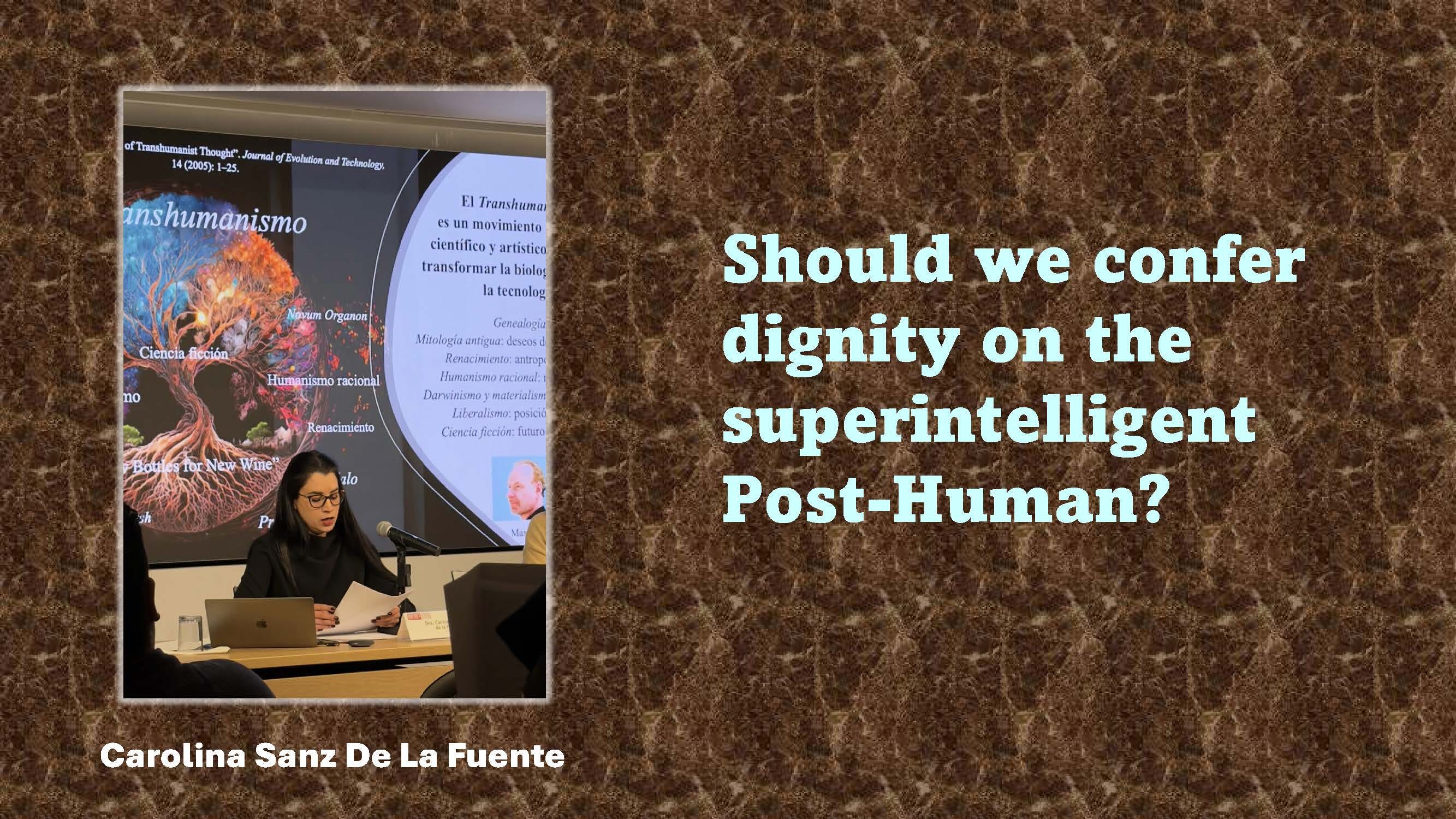
Meet Carolina Sanz de la Fuente
Carolina A. Sanz de la Fuente is an ethicist working at the intersection of computer science, philosophy, and theology. She is a founding member of the Center for the Study of Religion and Politics Network at the University of St Andrews and of the Latin-American research group Ciberteología at Universidad Iberoamericana. She taught applied ethics at the Tecnológico de Monterrey in Mexico City and has given talks at international conferences, including the European Academy of Religion and the American Academy of Religion. Her research specializes in the epistemological, ontological, social, and ethical implications of emerging technologies, with particular attention to AI and human–technology relationality. She holds a PhD in Ethics and Practical Theology from the University of Edinburgh and was an affiliate of the Center for Technomoral Futures at the University of Edinburgh Futures Institute, an MPhil in Philosophy (Cum Laude) from Universidad Iberoamericana and a BA in Humanities and Social Sciences (Summa Cum Laude) from Tecnológico de Monterrey.
Carolina A. Sanz de la Fuente enters the debate
Here is our debate proposition: Our global society should support the advance of AI technology for enhancing humanity and even generating a posthuman species. Dr. de la Fuente takes the affirmative. Yet she does so cautiously, taking seriously into account Pope Leo XIV’s emphasis on human dignity and the common good.
Caroline A. Sanz de la Fuente writes. In Magnifica Humanitas, Pope Leo observes that AI is not morally neutral. It might appear morally neutral because AI lacks a moral conscience, as it cannot judge right and wrong (§99). Nevertheless, even if AI itself lacks moral judgment, its impact is morally laden. AI is not purely objective, as it reflects its designers’ ideologies. In addition, AI must not be equated with human intelligence, as it only imitates some of our skills, mainly those related to data processing. Further, AI does not have feelings or undergo experiences that allow for inner growth, as it increases its functionality by processing more data and adapting to feedback. If we are not careful, fears the pope, AI will threaten human dignity and the common good. So, the Holy Father offers a public solution: “In the era of artificial intelligence, when human dignity is threatened by new forms of dehumanization, ours is the pressing duty to remain profoundly human” (§15).
What are the new forms of dehumanization that threaten our human dignity? Pope Leo critiques the technocratic paradigm and the use of AI when: shaping economic decisions with efficiency and profit (§92); monopolising and concentrating power in private companies (§109); environmental destruction (§101); exclusion of humans in evaluation processes (§103); normalising an anti-human vision that eliminates weaknesses (§112); disinformation (§132); inequalities (§144); exploitation and work replacement with machines (§148); human trafficking (§175). Even more dehumanizing is the implicit devaluation of the human species entailed in plans by transhumanists to replace Homo sapiens with a more highly evolved posthuman species.
Although I agree with the Pontiff that these practices are wrongful and do not contribute to the common good, these problems existed long before AI was programmed. It seems that dehumanizing others for individual benefit is a wrongful, yet well-established human practice.
So, one must distinguish the social problems that, although intensified by AI, existed before this technology was developed, from those directly created by AI.
In summary, dehumanization is the Vatican’s diagnosis. What should be the therapy? Protecting human dignity and promoting the common good, says the Holy See.
However, I worry about some of the anthropological assumptions at work in the pope’s prescription. The pontiff’s pathway to address the new era of artificial intelligence relies on protecting a notion of human dignity that reinforces both a hierarchical natural order and the boundaries that distinguish humans from machines. It’s called anthropocentrism. Ilia Delio called this anthropocentrism an outdated anthropology. I agree.
So, we must ask ourselves: did an anthropocentric view of reality lead to our current highly capitalist/digital era? Is the pope’s anthropology the same one that gave rise to the problem we face? If so, what caused the problem cannot be the solution. We must look for an alternative.
Consequently, any path towards embracing the AI era by reinforcing an anthropocentric hierarchical order should be subject to revision. Recent history shows that this inherited worldview has been among the causes that have led us to where we are in the environmental crisis. The anthropocentrism that justifies human dignity denies intrinsic value to the ecosphere within which we are embedded. So I ask: can part of the problem become the solution? Personally, I do not see how this can be done.
Moving on to the problems that can be situated within the post-AI programming timeline: AI imitating care and personal relationships (§100); undefined accountability when programming and using AI (§105); AI alignment in the hands of minorities (§107); AI fragmenting the education system (§145–146); AI producing digital addiction (§170). The Pontiff’s solution to address these new forms of dehumanization is to develop and use “AI to respect human dignity and truly serve the common good.” Moreso, he insists on one condition when working on AI’s moralization: “the possibility of openly discussing the ethical frameworks involved and subjecting them to shared standards of social justice” (§107).
Here is where I am torn. I strongly agree with Pope Leo on the following points. Yes, AI ought to truly serve the common good. Yes, the challenges of the AI era should be addressed by the Church’s Social Doctrine. Yes, when working on AI alignment, multiple voices ought to be part of the process. Yes, the public theologian plays a crucial role in the world of AI.
How can public theology provide genuine help? For starters, religion has always shaped, and continues to shape, the morality and ethical frameworks of a given society. But also, because the discourses of the techno-optimists are packed with religious language and pseudo-theological promises. See, for example: “Transhumanist Declaration”; Ray Kurzweil, The Singularity is Nearer (Kurzweil 2024); Max More, “H+: True Transhumanism,” and Nic Bostrom’s “Human Dignity and Bioethics.” Consequently, the Pontiff is right in worrying about the current technology’s deceitful goals and promises. Hava Tirosh-Samuelson, agreeing with Pope Leo, discerns a “false messianism” in AI, transhumanism, and posthumanism. Such false messianism especially warrants input from the public theologian.
The pontiff is engaging effectively in public theology. As an aside, let me mention that Ted Peters conscripted the public theologian almost a decade ago. He affirmed that “apologetic public theologians can offer the wider public a more realistic assessment of technology’s potential” (Peters, 2019).
Back to the pope’s public theology. I do not think Pope Leo’s reinforcement of an anthropocentric worldview that avoids dehumanization by remaining human and limits dignity to persons is the best approach. Why? As I said before, with or without AI and biotechnological enhancements, history has proven that dehumanizing others and dehumanizing the ecosphere is indeed a very human, wrongful activity. So, it seems to me that the problems we are facing in our hyper-technological/AI age do not result from blurring or breaking the so-called natural boundaries. Instead, these are caused by a lack of relationality and connectedness with the ‘other’, whether it be human, natural, or machine.
Are there any alternative solutions? If giving AI a sort of dignity or value -–as we did with animals while addressing their suffering–-is going to help us pause, reflect, and act before programming or using AI, then yes, we should do this. But which dignity are we talking about? Clearly not the same dignity we ascribe to humans.
A good alternative might be Nick Bostrom’s “dignity as a quality.” Accordingly, a quality warranting dignity “can be possessed by any number of types of object, which calls for recognition respect only. [This attitude] consists in giving appropriate recognition to some feature of its object in deliberating about what to do, and it can have any number of different sorts of things as its object.”
If programmers recognize –not admire– AI’s ability to learn, they might teach or program AI with more awareness, as they ought to treat this technology with a certain level of respect. The same extra layer of reflection can be fostered in users when using AI with ascribed dignity.
Let’s return to the debate proposition. Should our global society support the advancement of AI technology for enhancing humanity and even generating posthuman species? My answer is yes. Nonetheless, I want to make the following clarification. After years of researching AI and the latest technologies, I have come to realize that the problems humanity faces will not be solved by more data, a superintelligence, or new biotechnological enhancements. We dare not expect salvation from AI.
This is because our fundamental problems, past and present, stem from a lack of empathy, love, and relationality. Hence, evolving into a posthuman biological species or programming strong AI are not, on their own, the solution to humanity’s fundamental problems. If we want a better future, we also need to challenge our negative practices, ways of seeing, living, experiencing, and interacting with the world. Thus, the programming, use, and legislation of AI, along with posthuman transformations, need to be undertaken with an agapeic gaze. For it is agape that, by precluding a logic of control and domination, allows relational transformations.

Ted’s Rebuttal to Carolina Sanz de la Fuente
Ted Peters writes. Carolina Sanz de la Fuente affirms that our global society should support the advance of AI technology for enhancing humanity and even generating a posthuman species. This places her in opposition to Pope Leo XIV. Yet, at the same time, Carolina agrees with the pontiff that human dignity must be addressed. I thank Caroline for weighing in here.
Carolina sides with Ilia Delio on an important critique of Magnifica Humanitas, namely, the pope’s anthropology is based on an outdated metaphysics that treats human nature as fixed and even hierarchical.
To make it even more complicated, Carolina advances a post-anthropocentric worldview. The move from an anthropocentric to a post-anthropocentric perspective cannot sustain the idea of dignity as we have inherited it.
Carolina rightly points out that some of our transhumanists have conscientiously given the matter of dignity consideration. We can thank transhumanist Nick Bostrom, for example, for recognizing ambiguity in the history of the notion. On the one hand, dignity refers to a kind of excellence, a quality that some people possess while others do not. As a quality, dignity could in principle be enhanced.
On the other hand, Bostrom is aware that for both biblical Christians and the Enlightenment, dignity as Menschenwürde applies to all persons regardless of their excellence. Rather than confer dignity on a human person because of a quality he or she or they possess, dignity as intrinsic value is said here to be inherent, innate, inborn. It is the latter philosophical anthropology that underlies Western commitments to equality, freedom, justice, and human rights. It is the latter that is embraced by His Holiness, Pope Leo XIV. It is the latter that Ilia Delio rejects.
Like Delio, both Bostrom and de la Fuente reject this innate and universal human dignity. But for different reasons. For Bostrom, dignity is associated with a quality. As just mentioned, this implies that an enhanced quality could lead to an enhanced dignity. As a corollary, non-persons and perhaps post-persons with a desirable quality would also deserve to be treated with dignity. With this as background, Bostrom then speculates about a future technological utopia where all qualities are maximized, both human and posthuman qualities. Once enhanced desirable qualities are maximally enhanced, would we then need dignity any more?
In a future technological utopia, would there be any role left to play for Dignity as a Quality if the world, thanks to various political, medical, economic, and technological advances, reached a level of perfection far beyond its present troubled state? The question becomes perhaps especially acute if we suppose that the transhumanist aspiration to overcome some of our basic biological limitations were to be realized. Might the tension between Value and Reality then be relaxed in such a way that Dignity as a Quality would become meaningless or otiose? Nick Bostrom
Just what is Bostrom saying here? Bostrom is not adopting a redistribution of dignity to include the ecosphere or other terrestrial life forms marginalized by anthropocentrism.
If technological utopia would bring maximally enhanced qualities of every desirable kind, then everyone would deserve dignity. We would no longer need to rely on the doctrine of innate dignity to protect universal human rights. Dignity would be conferred on each posthuman due to one or another maximized excellence, not due to an innate claim. We would no longer need to protect individual rights in a utopia where those rights were thought to be inborn and universal. Did I get that right?
Despite this eschatological soteriology of enhanced dignity, Bostrom is in no hurry to deny dignity to human persons today. He is not a de-humanizer, exactly. Yet, the acids of transhumanist philosophy have dissolved the foundation upon which contemporary culture has constructed its protection of human dignity and its promotion of the common good. It is this that gives the pope nightmares.
Ilia Delio differs from Bostrom. Delio places our current reverence for the dignity of the human person within the larger evolutionary flow that promises the post-person, or more precisely, the ultrahuman. The ultrahuman will extend the interiority and individuation we have come to know through love into a cosmic consciousness that will realize the unity of all things. Teilhard de Chardin, says Delio, “believed that technology, taken up by love, could carry the human across a further threshold — into the ultrahuman: not a cleverer species but a deeper one, personalized upward into greater love, justice, and care for the whole.”
This should comfort Pope Leo XIV, because the posthuman as the “ultrahuman” will not leave the current dignified human behind. Rather, the dignity we know today will be swept up into the cosmic whole; it will only be enhanced tomorrow.
This should comfort Carolina Sanz de la Fuente too. Why? Because the realization of wholeness in cosmic consciousness will de-anthropocentrize dignity through the agape love Carolina appeals to.
This suggests the public theologian should be critically cautious of transhumanist soteriology. To defend ourselves from being misled by a counterfeit salvation, dignity protectors such as Pope Leo believe we should keep AI aligned to human dignity as we now understand it. “AI needs to serve human dignity, not transhumanist dreams,” writes North Carolina pastor Thomas Johnston in Covalence, an online publication of the Lutheran Alliance for Faith, Science, and Technology.
The dream Teilhard de Chardin and Ilia Delio ask for is a great deal more comprehensive and holistic than the one Bostrom or other transhumanists ask for. The theologian’s dream is not reducible to the transhumanist’s dream. AI alone will be unable to deliver cosmic consciousness united in love.
In the meantime, I, for one, would not want to risk surrendering human dignity for each individual person as we now understand it, even if the metaphysics on which it is constructed is being superseded. Unless and until the AI-influenced future assures us that human persons will not get lost in Bostrom’s hierarchical bruhaha with differing qualities competing for dominance, I hesitate to squander our inherited reverence for personal dignity by making a transhumanist FanDuel bet.
Substack PT 1028. Debating AI, Post-Humanity, and Carolina Sanz de la Fuente. Should we confer dignity on the superintelligent posthuman? Episode 9
Substack PT 1021. Debating AI, Post-Humanity, and Magnifica Humanitas. Should we confer dignity on the superintelligent posthuman? Episode 1
Substack PT 1022. Debating AI, Post-Humanity, and Arvin Gouw. Should we confer dignity on the superintelligent posthuman? Episode 2
Substack PT 1023. Debating AI, Post-Humanity, and Augustine Pamplany. Should we confer dignity on the superintelligent posthuman? Episode 3
Substack PT 1024. Debating AI, Post-Humanity, and Ilia Delio. Should we confer dignity on the superintelligent posthuman? Episode 4
Substack PT 1025. Debating AI: Rebuttal to Ilia Delio by Michael E Zimmerman. Should we confer dignity on the superintelligent posthuman? Episode 5
Substack PT 1026. Debating AI. Noreen Herzfeld asks: Is Claude Conscious? Should we confer dignity on the superintelligent posthuman? Episode 6
Substack PT 1027. Debating AI, Post-Humanity, and Ahmed Khater. Should we confer dignity on the superintelligent posthuman? Episode 7
Substack PT 1028. Debating AI, Post-Humanity, and Hava Tirosch-Samuelson. Should we confer dignity on the superintelligent posthuman? Episode 8
Substack H+ 2029. Epstein, Pope Leo XIV, and Christian Transhumanism. Michael West and Micah Redding on Technological Salvation. Part 8.
Substack PT 1028. Debating AI, Post-Humanity, and Carolina Sanz de la Fuente. Should we confer dignity on the superintelligent posthuman? Episode 9
▓
Meet Ted Peters. For Substack, Ted Peters posts articles and notices in the field of Public Theology. He is a pastor in the Evangelical Lutheran Church in America and an emeritus professor at Pacific Lutheran Theological Seminary and the Graduate Theological Union. His single-volume systematic theology, God—The World’s Future, is now in its 3rd edition. He has also authored God as Trinity plus Sin: Radical Evil in Soul and Society as well as Sin Boldly: Justifying Faith for Fragile and Broken Souls. Peters edited The Promise and Peril of AI and IA: New Technology Meets Religion, Theology, and Ethics (ATF 2024), and he recently published The Voice of Public Theology, with ATF Press. Soon to be released is a volume of essays, A Handbook on Astrobiology, Astrotheology, and Astroanthropology, co-edited with Carolina Azucena Sanz de la Fuente and Arvin Gouw, with Amsterdam University Press.
See his website: TedsTimelyTake.com and Patheos blog site.
▓\

References
Bostrom, Nick. 2026. “Dignity and Enhancement”. In Human Dignity and Bioethics: Essays Commissioned by the President’s Council on Bioethics. United States Govt Printing Office, 2008.
Checketts, Levi. 2022. “Homo Gubernator as a Teilhardian-Catholic Response to Transhumanism.” Religious Transhumanism and Its Critics, eds., Arvin M. Gouw, Brian Patrick Green, and Ted Peters, 341-354. Lanham, MD: Lexington.
Checketts, Levi. 2024. Poor Technology: Artificial Intelligence and the Experience of Poverty. Minneapolis, MN: Fortress.
Delio, Ilia. 2026. “Teilhard de Chardin on Technology and Human Evolution.” In Technologies of the Future Self: An Ethics for Transhuman Flourishing, eds., Georg Theiner and Alcibiades Malapi-Nelson, 335-362. New York: Palgrave Macmillan.
Gouw, Arvin. 2022. “Epilogue: Introducing a New Transhumanist Theology.” In Religious Transhumanism and Its Critics, eds., Arvin M. Gouw, Brian Patrick Green, and Ted Peters, 409-424. Lanham, MD: Lexington.
Herzfeld, Noreen. 2024. “The Eschatological Future of Artificial Intelligence: Savior or Apocalypse?” Eds., Beth Singler and Fraser Watts. Cambridge Companion to Religion and Artificial Intelligence. Cambridge UK: Cambridge University Press, 148-164.
Hughes, James. 2022. “Unitarian Universalists as Critical Transhumanists.” In Religious Transhumanism and Its Critics, eds, Arvin M. Gouw, Brian Patrick Green, and Ted Peters, 87-100. Lanham, MD: Lexington.
Krüger, Oliver, 2024. “Posthumanism and Digital Religion,” in Oxford Handbook of Digital Religion, eds., Heidi A. Campbell and Pauline Hope Cheong. Oxford: Oxford University Press, 544-561.
Kurzweil, Ray. 2024. The Singularity is Nearer. London: Penguin Random House.
Kurzweil, Ray. 2018. The Singularity is Near. London: Duckworth.
More, Max. et al. 2013. “Transhumanist Declaration (2012)”. In The Transhumanist Reader, ed., Max More and Natasha Vita-More, 54–55. Newark: Wiley-Blackwell.
More, Max. 2024. “H+: True Transhumanism”.
Peters, Ted, 2026. “Our Future Self: Cyber Enhancement and Spiritual Transformation,” eds., Georg Thiener and Alcibiades Malapi-Nelson, Technologis of the Future Self: An Ethic for Transhuman Flourishing. New York: Macmillan Praeger, 271-294.
Peters, Ted, ed. 2024. The Promise and Peril of AI and IA: New Technology Meets Religion, Theology, and Ethics. Adelaide: ATF.
Peters, Ted. 2019. “The Ebullient Transhumanist and the Sober Theologian.” Scientia et Fides 7:2: 97–117.
Peters, Ted. 2005. “Dignity.” Encyclopedia of Science, Technology, and Ethics, ed. by Carl Mitcham. New York: Macmillan, Thomson, Gale, 2:528-530.
Peters, Ted, and Gaymon Bennett. 2003. “Defining Human Life: Cloning, Embryos, and the Origins of Human Dignity.” Beyond Determinism and Reductionism, ed. by Mark L.Y. Chan and Roland Chia. Adelaide, Australia: ATF Press, 56-73.
Pope Francis. September 25, 2020. “Address of His Holiness Pope Francis to the 75th Session of the United Nations General Assembly.”
Pope Leo XIV. 2026. “Magnificata Humanitas.”
Tirosch-Samuelson, Hava. 2022. “The Transhumanist Pied Pipers: A Jewish Caution against False Messiahism.” In Religious Transhumanism and Its Critics, eds., Arvin M. Gouw, Brian Patrick Green, and Ted Peters, 183-214. Lanham, MD: Lexington.