

Debating AI, Post-Humanity, and Ahmed Khater
Should we confer dignity on the superintelligent posthuman? Episode 7

Substack PT 1025. Debating AI, Post-Humanity, and Ahmed Khater. Should we confer dignity on the superintelligent posthuman? Episode 7
Will the future of AI technology serve human dignity? Or undermine it?
In the People’s Republic of China, technological advance is already morally laden. Artificial Intelligence will be vaccinated with the values of Marxism and Maoism. Bill Drexel, writing in AI Frontiers, reports that official Chinese government regulations mandate that frontier AI systems must “uphold core socialist values”—that is, they must adhere to the Chinese Communist Party’s totalitarian view of history and morality. So vaccinated by these selected values, Chinese AI is not likely to contract the virus we know in the West as personal human dignity. Dignity is not a prescription written by a Marxist or Maoist pharmacist.
For children of the European Enlightenment, in contrast, universal human dignity is the chief diagnostic of political, legal, cultural, and philosophical health.
Today, some fear human dignity may become paralyzed as the technology of AI infects the globe with a superior way of thinking. This prompts us at the Voice of Public Theology Newsletter to debate selected matters.
Our debate is well underway. We began by listening carefully to the thoughtful voice of Pope Leo XIV’s encyclical, Magnifica Humanitas. To protect human dignity, the pontiff seeks to “disarm” AI advances that could lead to the evolution of a superintelligent posthuman species that would live on after Homo sapiens becomes extinct. No dignity transfer from us to them! We humans should keep our dignity, says the Holy Father.
Let us ask Ahmed Khater to weigh in. Dr. Ahmed M. Khater is one of my colleagues in Berkeley. Dr. Khater is Assistant Professor of Islamic Studies and Core Doctoral Faculty at the Graduate Theological Union and Adjunct Associate Professor of Islamic Studies at Saint Mary's College of California. Whereas we have been using the term dignity in this debate, you will see that Professor Khater directs our attention to an equivalent, namely, our human status in jurisprudence and our legal standing within Islamic law.
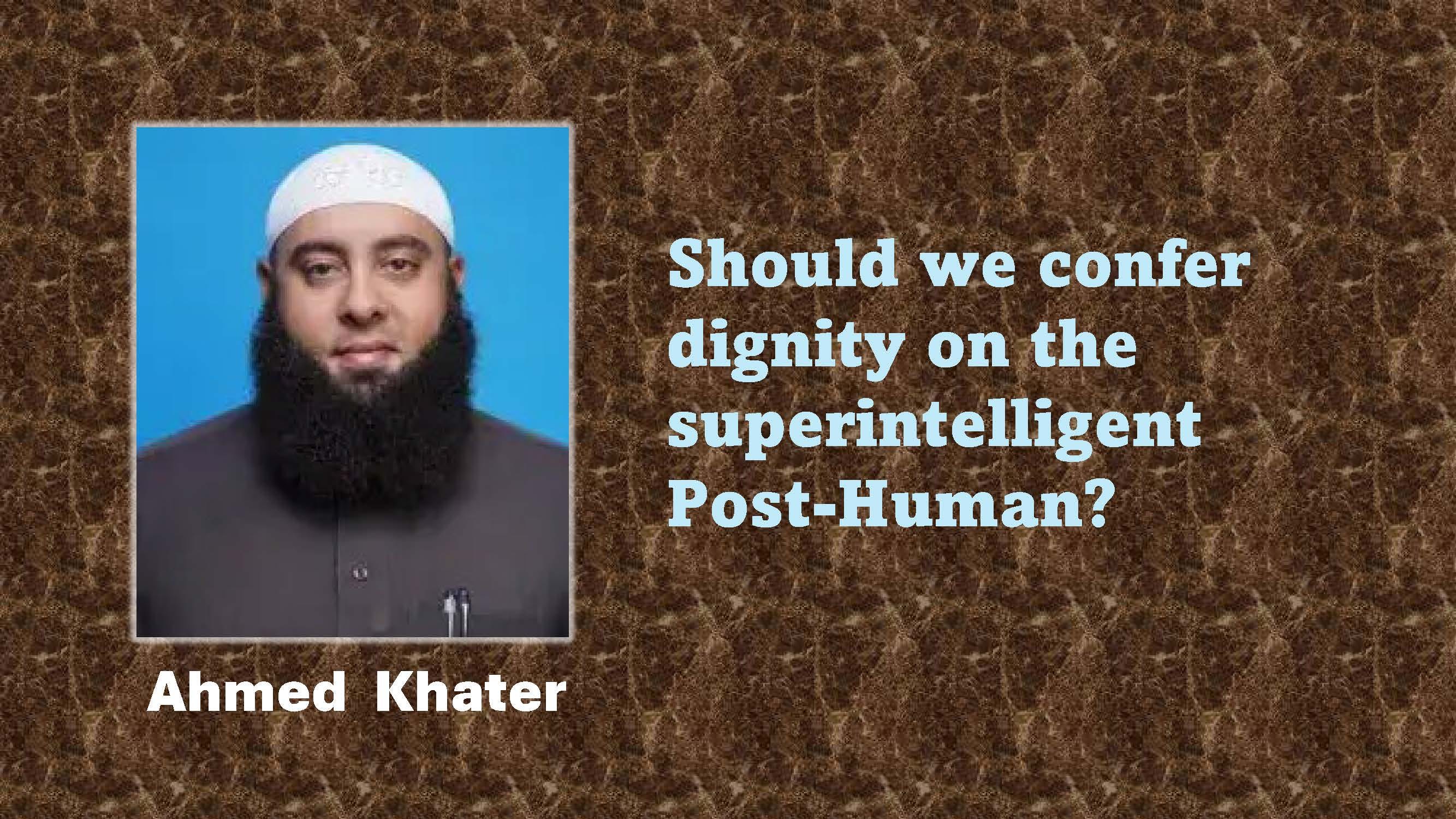
Here is our debate proposition.
Our global society should support the advancement of AI technology for enhancing humanity and even generating a posthuman species.
Ahmed Khater debates AI’s Future
Ahmed Khater writes. My position is negative. Society should continue to support the advancement of artificial intelligence and related technologies that improve human life, but it should not support the objective of creating a posthuman species.
From the perspective of Islamic jurisprudence, the central question is not whether artificial intelligence becomes increasingly intelligent or autonomous, but whether such developments are sufficient to establish independent legal capacity, moral accountability, or legal liability.
Classical Islamic law carefully distinguishes between operational autonomy and legal responsibility. These distinctions provide a principled framework for evaluating artificial intelligence without either resisting technological innovation or attributing to machines a legal status they do not possess. AI may perform increasingly sophisticated functions, but sophistication alone does not transform it into a bearer of rights, obligations, or moral accountability.
A significant contribution of the Islamic legal tradition is that it already possesses a sophisticated jurisprudence for allocating liability when harm is caused through intermediaries. Classical jurists examined liability arising from tools, trained animals, physicians, craftsmen, agents, hired workers, slaves, and other forms of mediated action, developing nuanced rules that distinguish between direct causation, indirect causation, negligence, control, and delegated authority. The question was never simply what produced the harm, but who remained legally responsible for it. These principles can be applied to artificial intelligence without requiring AI itself to become a legal or moral person. Depending upon the circumstances, liability may rest with the designer, manufacturer, programmer, owner, operator, employer, corporation, or regulator whose actions or negligence contributed to the harmful outcome. The increasing autonomy of AI therefore does not eliminate human responsibility; rather, it requires a more careful application of established principles of causation and liability.
This framework also clarifies the debate surrounding transhumanism. Islamic law does not oppose technological advancement or human enhancement as such. Technologies that restore health, compensate for disability, improve safety, or increase human capabilities may all serve legitimate legal and social objectives. The Muslim concern arises when technological progress is accompanied by the claim that machines, or a technologically modified posthuman species, should possess the same legal or moral status as the human person. Islamic jurisprudence reserves moral accountability (taklīf) and full legal capacity (ahliyyah) to the human being, while recognizing that certain institutions and legal entities may possess a limited juridical personality for specific legal purposes. These classical distinctions allow Islamic law to embrace technological innovation while preserving coherent principles of legal attribution and responsibility.
Accordingly, public policy should promote the continued development of artificial intelligence while establishing clear legal guardrails for its use. Rather than creating a new category of AI personhood, legal systems should refine existing principles of causation, negligence, agency, and institutional liability to govern increasingly autonomous technologies. Responsibility should remain attributable to the appropriate human actors according to their degree of control, design, deployment, supervision, or negligence. Islamic legal theory demonstrates that emerging technologies do not require abandoning traditional concepts of liability. Instead, they invite their careful application to new circumstances. In this way, society can encourage innovation while ensuring that legal responsibility and moral accountability remain firmly grounded in the human persons and institutions responsible for the development and use of these technologies.
Ted’s Rebuttal
Ahmed’s position is clear: he does not forecast nor endorse the conferral of dignity — the conferral of legal rights and responsibilities — to machine intelligence. Rather, AI must remain so attuned to human management that legal liability remains discernable and actionable. Depending upon the circumstances, liability may rest with the designer, manufacturer, programmer, owner, operator, employer, corporation, or regulator whose actions or negligence contributed to the harmful outcome, he says. The increasing autonomy of AI therefore does not eliminate human responsibility. Rather, it requires a more careful application of established principles of causation and liability.
In this debate, Professor Khater is most likely to side with those for whom AI has the status of “tool.” “We would do well to think of AI as a means rather than an end,” writes Noreen Herzfeld. “Like all technologies, AI is a tool” (Herzfeld, 2024, 162). This implies that we human beings cannot relinquish our moral or legal responsibilities for what AI does.
This further implies that religious and governmental authorities have a responsibility to formulate public policy in terms of guidelines and guardrails. I enthusiastically agree with this.
Thank you, Professor Ahmed Khater.
Substack PT 1025. Debating AI, Post-Humanity, and Ahmed Khater. Should we confer dignity on the superintelligent posthuman? Episode 7
Substack PT 1021. Debating AI, Post-Humanity, and Magnifica Humanitas. Should we confer dignity on the superintelligent posthuman? Episode 1
Substack PT 1022. Debating AI, Post-Humanity, and Arvin Gouw. Should we confer dignity on the superintelligent posthuman? Episode 2
Substack PT 1023. Debating AI, Post-Humanity, and Augustine Pamplany. Should we confer dignity on the superintelligent posthuman? Episode 3
Substack PT 1024. Debating AI, Post-Humanity, and Ilia Delio. Should we confer dignity on the superintelligent posthuman? Episode 4
Substack PT 1025. Debating AI: Rebuttal to Ilia Delio by Michael E Zimmerman. Should we confer dignity on the superintelligent posthuman? Episode 5
Substack PT 1026. Debating AI. Noreen Herzfeld asks: Is Claude Conscious? Should we confer dignity on the superintelligent posthuman? Episode 6

▓
Meet Ted Peters. For Substack, Ted Peters posts articles and notices in the field of Public Theology. He is a pastor in the Evangelical Lutheran Church in America and an emeritus professor at Pacific Lutheran Theological Seminary and the Graduate Theological Union. His single-volume systematic theology, God—The World’s Future, is now in its 3rd edition. He has also authored God as Trinity plus Sin: Radical Evil in Soul and Society as well as Sin Boldly: Justifying Faith for Fragile and Broken Souls. Peters edited The Promise and Peril of AI and IA: New Technology Meets Religion, Theology, and Ethics (ATF 2025), and he recently published The Voice of Public Theology, also with ATF Press. Soon to be released is a volume of essays, A Handbook on Astrobiology, Astrotheology, and Astroanthropology, co-edited with Carolina Azucena Sanz de la Fuente and Arvin Gouw, with Amsterdam University Press.
See his website: TedsTimelyTake.com and Patheos blog site.
▓
References
Delio, Ilia. 2026. “Teilhard de Chardin on Technology and Human Evolution.” In Technologies of the Future Self: An Ethics for Transhuman Flourishing, eds., Georg Theiner and Alcibiades Malapi-Nelson, 335-362. New York: Palgrave Macmillan.
Gouw, Arvin. 2022. “Epilogue: Introducing a New Transhumanist Theology.” In Religious Transhumanism and Its Critics, eds., Arvin M. Gouw, Brian Patrick Green, and Ted Peters, 409-424. Lanham, MD: Lexington.
Herzfeld, Noreen. 2024. “The Eschatological Future of Artificial Intelligence: Savior or Apocalypse?” Eds., Beth Singler and Fraser Watts. Cambridge Companion to Religion and Artificial Intelligence. Cambridge UK: Cambridge University Press, 148-164.
Hughes, James. 2022. “Unitarian Universalists as Critical Transhumanists.” In Religious Transhumanism and Its Critics, eds, Arvin M. Gouw, Brian Patrick Green, and Ted Peters, 87-100. Lanham, MD: Lexington.
Krüger, Oliver, 2024. “Posthumanism and Digital Religion,” in Oxford Handbook of Digital Religion, eds., Heidi A. Campbell and Pauline Hope Cheong. Oxford: Oxford University Press, 544-561.
Peters, Ted. 2005. “Dignity.” Encyclopedia of Science, Technology, and Ethics, ed. by Carl Mitcham. New York: Macmillan, Thomson, Gale, 2:528-530.
Peters, Ted, and Gaymon Bennett. 2003. “Defining Human Life: Cloning, Embryos, and the Origins of Human Dignity.” Beyond Determinism and Reductionism, ed. by Mark L.Y. Chan and Roland Chia. Adelaide, Australia: ATF Press, 56-73.
Peters, Ted, ed. 2024. The Promise and Peril of AI and IA: New Technology Meets Religion, Theology, and Ethics. Adelaide: ATF.
Peters, Ted, 2026. “Our Future Self: Cyber Enhancement and Spiritual Transformation,” eds., Georg Thiener and Alcibiades Malapi-Nelson, Technologis of the Future Self: An Ethic for Transhuman Flourishing. New York: Macmillan Praeger, 271-294.
Pope Francis. September 25, 2020. “Address of His Holiness Pope Francis to the 75th Session of the United Nations General Assembly.”
Pope Leo XIV. 2026. “Magnificata Humanitas.”
Tirosch-Samuelson, Hava. 2022. “The Transhumanist Pied Pipers: A Jewish Caution against False Messiahism.” In Religious Transhumanism and Its Critics, eds., Arvin M. Gouw, Brian Patrick Green, and Ted Peters, 183-214. Lanham, MD: Lexington.
Trothen, Tracy, and Calvin Mercer. 2025. “AI, IA, and Theological Anthropology.” The Promise and Peril of AI and IA: New Technology Meets Religion, Theology, and Ethics. Ed., Ted Peters, 141-162. Adelaide: ATF.