


Substack PT 1039. Debating AI and Mormon Transhumanism with Lincoln Cannon. Should we confer dignity on the superintelligent posthuman? Episode 19
“The most important thing to know about AI,” avers technology historian Yuval Noah Harari, “is that AI is not a tool.” What?! “It is an agent with its own hands….Agents…have the ability to make decisions by itself….able to change by itself in ways its creators don’t anticipate….AI agency and creativity already surpass human agency and creativity.” Our technological creature already surpasses its creator, namely, us.
Does this mark a step from humanity to posthumanity? Our transhumanist friends certainly think so. This means we must ask the theological question: how does the future of the AI revolution fit within biblical anthropology?’
Let’s ask Mormon transhumanist Lincoln Cannon. If you have not yet met Lincoln Cannon, you have a treat coming. Lincoln is a systematic theologian with a futurist impulse who has planted the seeds of Mormon Transhumanism and is now watching it grow. He founded the Mormon Transhumanist Association in 2006 and continues to nourish his futurist vision through creative interaction with advances in technology.
When my theological crewmates Arvin Gouw and Brian Patrick Green edited our book, Religious Transhumanism and Its Critics, we could not press forward without a chapter by Lincoln Cannon. His contribution is most informative and exciting.

Our Substack series, “Debating AI,” was launched in response to the protean encyclical, Magnifica Humanitas, by Pope Leo XIV. Recall how the pontiff contended that we need to slow down the advance of AI in the direction of human enhancement and the evolution of a post-human species. Why? In order to protect the dignity of today’s human species, whom God loves despite our frailties, stumblings, and even sinfulness. The human race needs to forestall the development of superintelligent posthumanity, said the pope, in order to protect human dignity and promote the common good.
Not every theologically informed scholar shares the pope’s point of view. Christian transhumanists and other religious transhumanists look forward to the evolution of a superintelligent posthuman species. With this in mind, we have formulated a debate proposition.
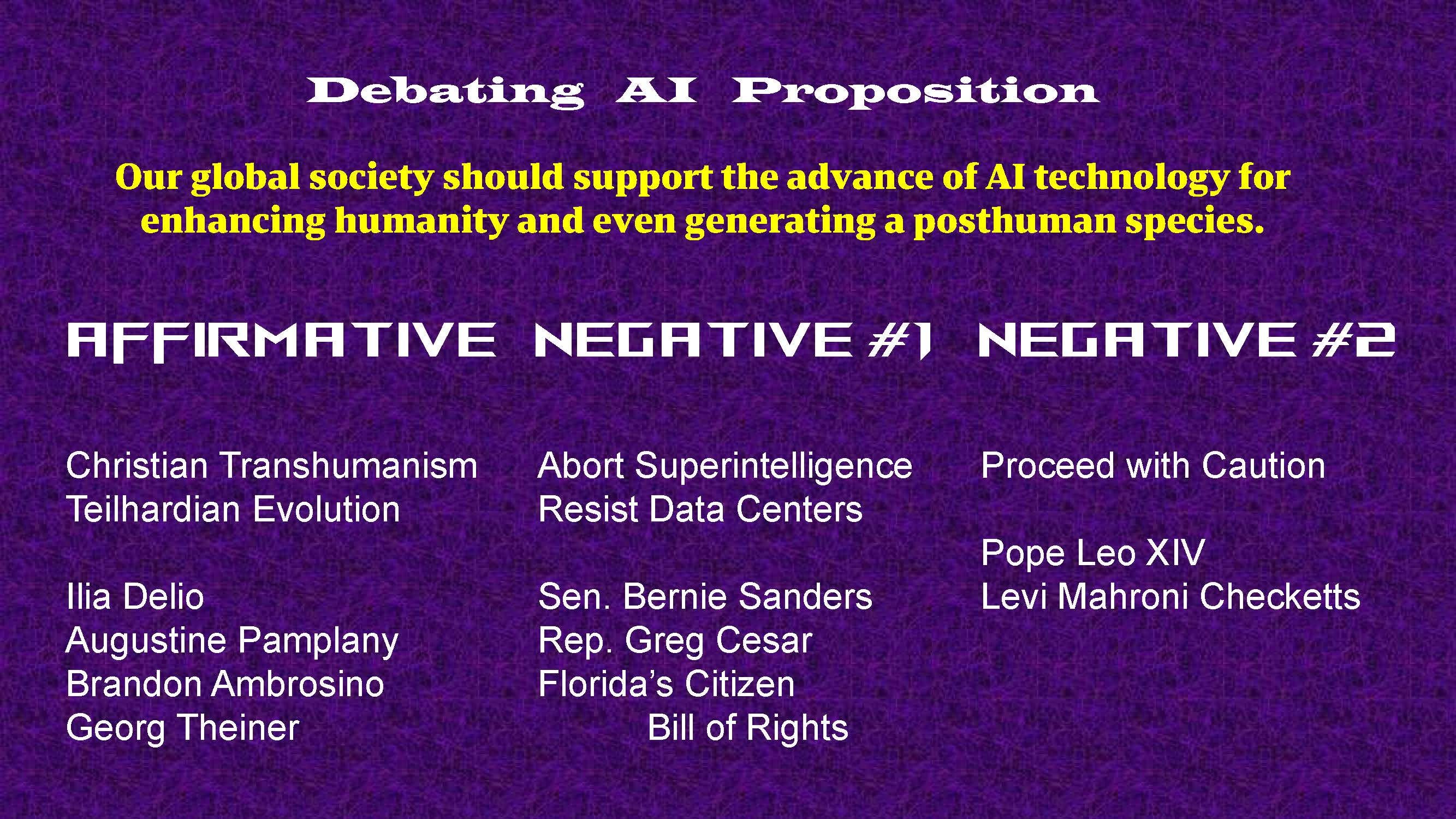
Our global society should support the advance of AI technology for enhancing humanity and even generating a posthuman species.
Let’s ask Lincoln Cannon to take a position and provide an argument for us to ponder.

Lincoln Cannon takes the affirmative
Lincoln Cannon writes. I affirm the proposition: our global society should support the advance of AI technology for enhancing humanity and, yes, even generating a posthuman species -- but superhuman rather than subhuman. And it seems to me that most, on both sides of the debate, are using a dubious account of dignity. I want to challenge that, because a better account of dignity changes what “support” actually means in practice.
Pope Leo XIV grounds dignity in the image of God, conferred on each individual human, then extended to humanity as a whole. By his reasoning, if humanity has dignity, any advance that supersedes humanity threatens that which he’s defending. His encyclical insists humanity “must never be replaced or surpassed.”
Ilia Delio answers, rightly in my estimation, that dignity isn’t “a static substance walled off from the world.” Instead, she continues, dignity is “the direction of the movement,” toward that which Teilhard de Chardin called “Omega,” and she calls “love.” Does an advance “carry love into greater particularity, or reduce persons to data and performance?”
I agree with Delio’s diagnosis more than her remedy. Restricting dignity to possession does undermine notions of dignified change and transformation -- or repentance and transfiguration, as advocated by the same Bible that confers on us the image of God. But restricting dignity to trajectory has its own problem. It undermines the notion of dignified divergence -- or, as Jesus taught, loving our enemies.
From Christianity, Mormon theology inherits, interprets, and emphasizes the doctrine of theosis. “God himself was once as we are now, and is an exalted man, and sits enthroned in yonder heavens!” That’s how Joseph Smith put it, and continued, “You have got to learn how to be Gods yourselves, and to be kings and priests to God, the same as all Gods have done before you.” Such Gods sound like a posthuman species to me.
But, as I said, Mormons inherit this from Christianity. In the Bible, Peter promises that we may participate in the nature of God. Paul witnesses that we may be joint-heirs in the glory of God, if we suffer with Christ. And Jesus prays that we may be one with him, as he’s one with God.
If we take the Christian doctrine of theosis seriously, by any of its most prominent interpretations, and if we wish to do so coherently, we must also embrace an account of dignity that permits real transformation (such as that from humanity into Godhood), as well as real divergence (such as that between humans and God). Accounts of dignity as possession and trajectory both fail, I contend, because they would locate dignity in an entity. And the entity, in itself, isn’t the real problem.
Michael Zimmerman warns that AI may “quickly realize that the very existence of (most) humans impedes its own drive toward ever greater power.” This suggests the mechanism of indignity that both Pope Leo and Delio may actually fear. And it’s mostly orthogonal to kinds of intelligence (human or otherwise) and final goals (love or otherwise).
The real problem is any intelligence, any power, that concentrates faster than accountability. A superintelligent posthumanity that concentrates decision-making into a singleton reduces everyone else to a petitioner, at best, if not a slave. But the same is also true of all-too-human bureaucracies, no AI required. In contrast, decentralize power, and dignity survives any differences in kinds of intelligence and final goals.
A better account locates dignity between entities. Instead of adjudicating the dignity of entities, we would adjudicate the dignity of relationships. Then the question becomes, does an advance expand our capacity to fulfill and reconcile the diversity of our desires?
If that sounds like hedonism, you’ve misunderstood. I’m just repeating what Jesus says in the Bible. He says, “If you love me, keep my commands.” But he says that only after saying, and repeating as if he thinks we won’t believe him, “I will do whatever you ask in my name ... You may ask me for anything in my name, and I will do it.”
This is the God who consoles, heals, and raises the dead. This is the God who lays down his life for his friends, and rises bodily from the grave. This is the God who asks us to be like him, do the works he does, and do even greater things. He shows us the God worthy of worship -- of emulation.
That brings us back to the beginning, in more ways than one. I invite you, with Pope Leo XIV and me, to affirm the image of God as exemplified by Jesus. Clearly, that includes consoling, healing, and raising others to participate in our nature, both our suffering and whatever glory we might have, as long as they would so choose. And I haven’t read anything about Jesus adjudicating the kind of intelligence, final goals, or even consciousness of an entity who expresses such desire.
So, yes, I support the advance of AI and the generation of a posthuman species. More than that, I advocate their and our transformation into compassionate and creative superhumanity -- transfiguration into Godhood. But we must do this together, persistently decentralizing power, and ensuring that no single entity, human or artificial or otherwise, can ever dominate the rest of us. Only on condition of dignified relationships can “posthuman” ever name inheritance rather than eviction.
Rebuttal by Levi Mahroni Checketts, Hong Kong Baptist University
Levi Mahroni Checketts writes. I grew up Mormon. One peculiar fact that distinguishes Mormons from (orthodox) Christians is a lack of Logos theology. In the third verse of Adeste Fideles, Mormons belt out a triumphant “Son of the Father, now in flesh appearing!” instead of the original “Word of the Father.” Why is this significant? Beyond Genesis 1:27, John 1:14 is a key for understanding human dignity. “The Word became flesh and pitched his tent among us.”
Theologically, theosis must be tied to Kenosis -- God deigned to become a human like us, and in so doing, elevated humanity. Not because we merit it, but precisely because we do not. “But God demonstrates his own love for us in this: While we were still sinners, Christ died for us,” Paul tells us in Romans 5:8. This mysterium tremendum balks at the transhumanist concept of dignity. Whatever else may be augmented, dignity is not what transhumanists might say it is.
That Mormon philosophy can diverge sharply from Roman Catholic theology is not surprising on this front. Mormons believe that ”the glory of God is intelligence.” While Thomas Aquinas suggests our status as imago Dei parallels God’s rationality in the Second Part of the Summa, Catholicism is not wedded to this position. So while Teilhard de Chardin and Ilia Delio can affirm intelligence as the key factor, the paradox of our faith is what the Pope affirms in Magnifica Humanitas paragraph 122: the frailty and fallenness of humanity is also part of our magnificence.
St Lawrence earned his martyrdom by presenting to Valerian the ”treasures” of the Church are found in the poor, the crippled, the marginalized. Or, to remind Mr. Cannon, the same Christ who calls us to serve others reverses our expectations: “The last shall be first, and the first shall be last” (Matt. 20:16). Truly, we should not lose track of Paul’s reminder that the death of God Incarnate is “foolishness to Gentiles” (1 Corinthians 1:23).
Transhumanism, even in its religious iterations, resembles a type of Nietzschean master morality. Goodness, Nietzsche proclaimed, ought to be understood as power, and those who will pursue the most authentic life (i.e., the Übermensch) put no stock in conventional moralities that warn us against Promethean hubris.
In short, like Nietzsche, the transhumanist scoffs at the Christian praise of weakness, even if it can focus on “relationships” as Cannon does. Certainly it is better, more dignified, to be stronger, smarter, more powerful? Cannon ties dignity to the advance of our desires; Nietzsche would call that will to power.
But the “slave morality” of Christianity did not die with the Roman persecutions. It spread. And everywhere Christianity has gone, it has provoked the powerful. The scandalous “Good News to the poor” affirms dignity where the powerful deny it.
The Romans could not snuff out dignity to the poor, nor could the Samurai, the (Korean) Yangban, nor the (Chinese) boxers (to offer some examples from my part of the world). The secret of the Church’s universality is its rejection of elitist anthropology. Paul did not supersede Peter, even with his educational pedigree.
Hava Tirosh-Samuelson falls in line with the Pope on this question—what a curious fact that the head of the Roman Catholic Church finds more common ground with a Jewish historian than with many Christians debating this question! Perhaps I can intuit why —Tirosh-Samuelson is deeply influenced by the thought of Hans Jonas, the first philosopher to take seriously the meaning of evolution for philosophy. Jonas’s views on cybernetics, the moral value of organic life, and the wrongfulness of technological immortality put him squarely against the transhumanists who would come after him.
Jonas’s entire moral philosophy ties into his view of natality, which he shares with his lifelong friend, Hannah Arendt. She contended that new human life was the precondition for a real future, and not a cycle of repetition, as it allows for new possibilities. But where does Arendt derive this idea? While she (and Jonas in his own vein) makes a convincing philosophical justification for this focus, she roots it in a passage every Christian remembers on December 25: “Unto us a child is born” (Isaiah 9:6).
To come full circle — St. John tells us that God deigned to be a human being, and in so doing, our human frailty is dignified. But the nativity narrative reminds us that the human Christ entered this world in the most humble circumstances — a weak infant born in the Roman-occupied province of Judea in a barn. The Christian tradition affirms that the most dignified is he about whom Isaiah wrote, “He had no stately form or majesty to attract us, no beauty that we should desire Him. He was despised and rejected by men, a man of sorrows, acquainted with grief. Like one from whom men hide their faces, He was despised, and we esteemed Him not” (Isaiah 53:2-3).
So where does Pope Leo XIV derive his idea of dignity from? From nothing short of the great Christian mystery that the Lord of the universe was born in a stable, lived as an itinerant preacher in a backwater colony, and suffered public execution at the hands of an unjust system.
Ted’s Conclusion
Ted Peters writes. Note how Lincoln Cannon, like others sympathetic to Christian transhumanism or Teilhardian evolutionism, is unwilling to give up on human dignity. On this, they agree with Pope Leo XIV. Yet, after incorporating evolution into biblical eschatology with theosis or something akin to it, they anticipate a future sanctified human or posthuman creation. Levi Mahroni Checketts objects, because, like the pontiff, our dignity is conferred on us by God while we were still weak, marginalized, and sinful. This implies that we do not need to evolve higher to make a claim on dignity.
As you can see, my comments do not here count as a rebuttal to Lincoln, Levi or to other religious transhumanists who want to conscript H+ into their doctrines of sanctification and eschatology. I’m merely engaging in discourse clarification.
God has a plan for the renewal of creation, for the redemption of creation. It is right that our generation asks: will AI technology contribute to that renewal, to our theosis? We have seen that Ilia Delio, Augustine Pamplany, Brandon Ambrosino, and Georg Theiner certainly think so. We can add Lincoln Cannon, but certainly not Levi Mahroni Checketts. Debating AI continues. Stay tuned.
Substack PT 1039. Debating AI and Mormon Transhumanism with Lincoln Cannon. Should we confer dignity on the superintelligent posthuman? Episode 19
H+ 1013 Radical Life Extension? Cybernetic Immortality? Or Resurrection of the Body?
Substack PT 1021. Debating AI, Post-Humanity, and Magnifica Humanitas. Should we confer dignity on the superintelligent posthuman? Episode 1
AI and FAITH. “Magnifica Humanitas: AI and Faith at the Vatican”
AI and FAITH. “The Urgency of Reclaiming Human Agency”
VIDEO. “How then shall we live? Meaning in the Age of AI” St. Gregory Nyssa Epis SF, June 7, 2026
Substack PT 1022. Debating AI, Post-Humanity, and Arvin Gouw. Should we confer dignity on the superintelligent posthuman? Episode 2
Substack PT 1023. Debating AI, Post-Humanity, and Augustine Pamplany. Should we confer dignity on the superintelligent posthuman? Episode 3
Substack PT 1024. Debating AI, Post-Humanity, and Ilia Delio. Should we confer dignity on the superintelligent posthuman? Episode 4
Substack PT 1025. Debating AI: Rebuttal to Ilia Delio by Michael E Zimmerman. Should we confer dignity on the superintelligent posthuman? Episode 5
Substack PT 1026. Debating AI. Noreen Herzfeld asks: Is Claude Conscious? Should we confer dignity on the superintelligent posthuman? Episode 6
Substack PT 1027. Debating AI, Post-Humanity, and Ahmed Khater. Should we confer dignity on the superintelligent posthuman? Episode 7
Substack PT 1028. Debating AI, Post-Humanity, and Hava Tirosch-Samuelson. Should we confer dignity on the superintelligent posthuman? Episode 8
Substack H+ 2029. Epstein, Pope Leo XIV, and Christian Transhumanism. Michael West and Micah Redding on Technological Salvation. Part 8.
Substack PT 1029. Debating AI, Post-Humanity, and Carolina Sanz de la Fuente. Should we confer dignity on the superintelligent posthuman? Episode 9
Substack PT 1030. Debating AI, Post-Humanity, and Calvin Mercer. Should we confer dignity on the superintelligent posthuman? Episode 10
Substack PT 1031. Debating AI, Post-Humanity, and Levi Mahroni Checketts. Should we confer dignity on the superintelligent posthuman? Episode 11
Substack PT 1032. Debating AI: Techlash Against Frankenstein? Should we confer dignity on the superintelligent posthuman? Episode 12
Substack PT 1033. Debating AI and the Ban Artificial Superintelligence Act. Should we confer dignity on the superintelligent posthuman? Episode 13
Substack PT 1034. Debating AI, Post-Humanity, and Braden Molhoek. Should we confer dignity on the superintelligent posthuman? Episode 14
Substack PT 1035. Debating AI’s Fall into Sin. Should we confer dignity on the superintelligent posthuman? Episode 15
Substack PT 1036. Debating AI’s Future With or Without Us. Should we abort our posthuman children before they are born? Episode 16
Substack PT 1037. Debating AI, Post-Humanity, and Brandon Ambrosino. Should we confer dignity on the superintelligent posthuman? Episode 17
Substack PT 1038. Debating AI, Post-Humanity, and Georg Theiner. Should we confer dignity on the superintelligent posthuman? Episode 18
▓
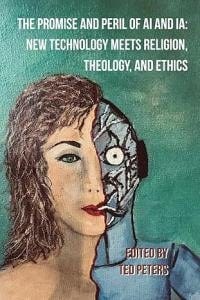
Meet Ted Peters. For Substack, Ted Peters posts articles and notices in the field of Public Theology. He is a pastor in the Evangelical Lutheran Church in America and an emeritus professor at Pacific Lutheran Theological Seminary and the Graduate Theological Union. His single-volume systematic theology, God—The World’s Future, is now in the 3rd edition. He has also authored God as Trinity plus Sin: Radical Evil in Soul and Society, as well as Sin Boldly: Justifying Faith for Fragile and Broken Souls. In 2023 he published The Voice of Public Theology with ATF Press. More recently, he has published an edited volume, Promise and Peril of AI and IA: New Technology Meets Religion, Theology, and Ethics (ATF 2025), and, along with Arvin Gouw, an edited collection, The CRISPR Revolution in Science, Religion, and Ethics (Bloomsbury 2025). Soon to be released is a volume of essays, A Handbook on Astrobiology, Astrotheology, and Astroanthropology, co-edited with Carolina Azucena Sanz de la Fuente and Arvin Gouw, with ATF.
See his website: TedsTimelyTake.com and Patheos blog site.
▓